From Washington to Trump.
All 47 presidencies, in order: what each president did, what people called them at the time, how historians rank them now and how popular they were. Polls only go back to FDR; before that, elections were the scoreboard.
"In their own words" sections are first-person summaries written by Politically Irritated from the historical record. They are not real quotes. Quotes from historians are word for word and linked to where they appear.
The record, at a glance
Taller bars are ranked higher by historians: the average of the C-SPAN 2021, Siena 2022 and APSA 2024 surveys. Tap a bar to jump to that president.
The founders 1789–1828
- #1
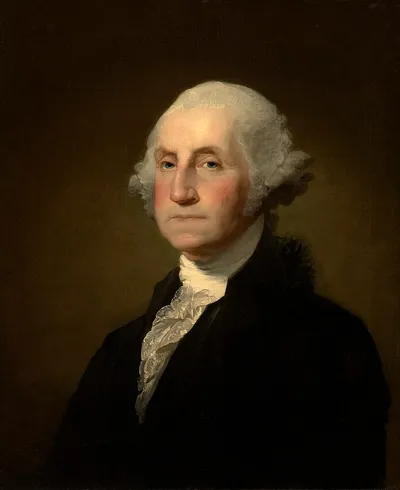
1789–1797 · 1st president
George Washington
In their own wordsI was the first president, so almost everything I did set a precedent. I built the first cabinet, backed Alexander Hamilton's plan for federal debt and a national bank, and signed the law putting the capital on the Potomac. I personally led militia troops to put down the Whiskey Rebellion, and I declared neutrality when Britain and France went to war. The Jay Treaty I approved set off angry protests. I enslaved people throughout my presidency and signed the Fugitive Slave Act of 1793. I stepped down after two terms, a precedent that held until 1940.
What they did
- Created the first cabinet and signed the Judiciary Act of 1789, establishing the federal courts
- Backed Hamilton's financial plan, including federal assumption of state debts and the First Bank of the United States
- Issued the 1793 Neutrality Proclamation; the 1795 Jay Treaty avoided war with Britain but sparked fierce opposition
- Sent militia to suppress the 1794 Whiskey Rebellion; signed the Fugitive Slave Act of 1793
How historians rank them
The first president, and the one every other gets measured against.
How popular they were
- Won 1788: 69 of 69 electoral votes
- Won 1792: 132 of 132 electoral votes
Elected before states counted a national popular vote.
What people called them
- "Father of His Country" First in print in a 1778 Pennsylvania German almanac; common by his 1789 inauguration.
“The trust and confidence Washington inspired made possible the creation of the presidency and helped establish the executive branch.”
Lindsay M. Chervinsky, Miller Center, "George Washington: Impact and Legacy" (last updated 2025) - #2
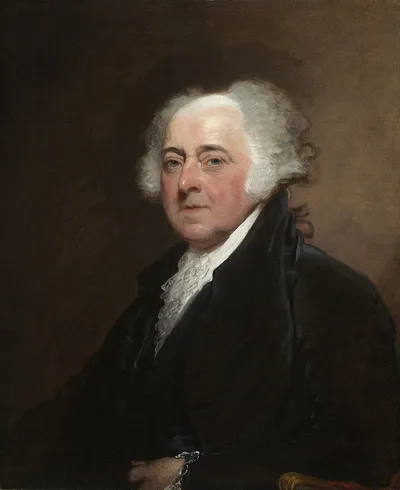
1797–1801 · 2nd president
John Adams
In their own wordsI took over from Washington just as relations with France fell apart. After the XYZ Affair, when French officials demanded bribes from our diplomats, we fought an undeclared naval war called the Quasi-War. I created the Department of the Navy and built up the fleet, but I also sent new peace envoys, which split my own Federalist Party. I signed the Alien and Sedition Acts, and newspaper editors who criticized my government were jailed under them. I lost the 1800 election to Thomas Jefferson, and before leaving I appointed John Marshall as Chief Justice.
What they did
- The XYZ Affair led to the Quasi-War, an undeclared naval war with France (1798–1800)
- Created the Department of the Navy in 1798 and expanded the fleet
- Signed the Alien and Sedition Acts (1798); critics, including newspaper editors, were prosecuted
- Reached peace with France in the Convention of 1800; appointed John Marshall Chief Justice
How historians rank them
Ranked below George Washington, the only president before them.
How popular they were
- Won 1796: 71 of 138 electoral votes
No scientific polls existed yet, so elections were the only measure of popularity.
What people called them
- "His Rotundity" Senator Ralph Izard's joke in 1789, during the Senate debate over presidential titles while Adams was VP.
“Adams has been justifiably censured for having signed the Alien and Sedition Acts, although it is important to note that he neither openly advocated their passage nor personally implemented them.”
C. James Taylor, Miller Center, "John Adams: Impact and Legacy" (last updated 2023) - #3
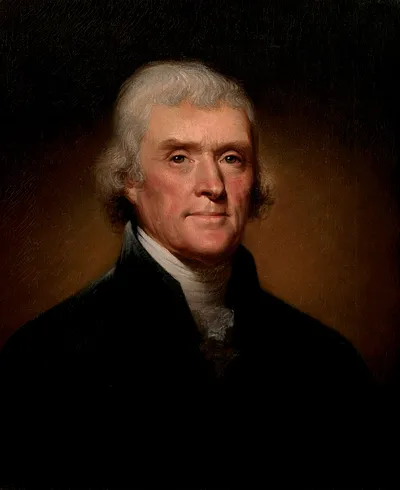
1801–1809 · 3rd president
Thomas Jefferson
In their own wordsI won in 1800 after a tie with Aaron Burr that the House had to break, and power passed peacefully from Adams's party to mine. I cut taxes and the national debt and sent the Navy against the Barbary states. In 1803 I bought the Louisiana Territory from France, even though I doubted the Constitution allowed it, and sent Lewis and Clark west. I signed a ban on importing enslaved Africans, yet I enslaved hundreds of people myself. My 1807 Embargo Act badly hurt the economy and was repealed in 1809.
What they did
- Purchased the Louisiana Territory from France in 1803, roughly doubling the nation's size
- Sent the Lewis and Clark Expedition (1804–1806) to explore the West
- Fought the First Barbary War (1801–1805) against North African states over piracy and tribute
- Signed the 1807 slave-importation ban; his 1807 Embargo Act caused economic damage and was repealed
How historians rank them
Ranked above 1 of the 2 presidents before them.
How popular they were
- Won 1800: 73 of 138 electoral votes
- Won 1804: 162 of 176 electoral votes
No scientific polls existed yet, so elections were the only measure of popularity.
What people called them
- "Sage of Monticello" Common name for him in retirement; a visitor recalled first seeing "the sage of Monticello" around 1822.
“Known for his hostility to strong central government and the judicial overreach of the Supreme Court under John Marshall, Jefferson nonetheless jettisoned strict construction when the nation's vital interests were threatened.”
Peter Onuf, Miller Center, "Thomas Jefferson: Impact and Legacy" (last updated 2025) - #4
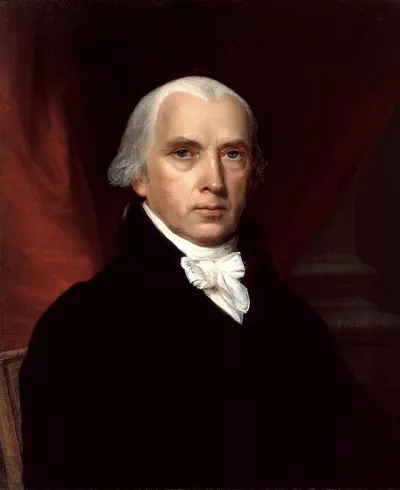
1809–1817 · 4th president
James Madison
In their own wordsI led the country into the War of 1812 against Britain over attacks on American trade, the forced recruitment of our sailors, and British support for Native resistance in the West. The war went badly at first: our invasion of Canada failed, and in 1814 British troops burned the Capitol and the White House. New England Federalists protested at the Hartford Convention. The Treaty of Ghent ended the war with no land changing hands. Afterward I signed a charter for a second national bank but vetoed a roads-and-canals bill. I enslaved people throughout my life.
What they did
- Asked Congress to declare war on Britain in 1812 over impressment and trade restrictions
- British forces burned Washington, D.C., including the Capitol and White House, in August 1814
- The Treaty of Ghent (1814) ended the War of 1812, restoring prewar borders
- Signed the charter for the Second Bank of the United States (1816); vetoed the 1817 Bonus Bill
How historians rank them
Ranked above 1 of the 3 presidents before them.
How popular they were
- Won 1808: 122 of 175 electoral votes
- Won 1812: 128 of 217 electoral votes
No scientific polls existed yet, so elections were the only measure of popularity.
What people called them
- "Father of the Constitution" Hailed this way even in his own lifetime for drafting and promoting the Constitution and Bill of Rights.
“Assessments of Madison’s presidency usually hinge on assessments of the War of 1812. The causes and aims of the war today still seem undefined, and the outcome of the war seems equally murky.”
Tyson Reeder, Miller Center, "James Madison: Impact and Legacy" (last updated 2024) - #5
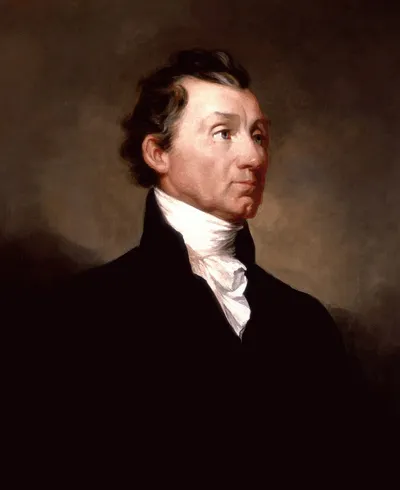
1817–1825 · 5th president
James Monroe
In their own wordsMy presidency is called the Era of Good Feelings because the Federalist Party faded and I ran for reelection in 1820 with no real opponent. Still, the Panic of 1819 brought a severe depression. When Missouri asked to join as a slave state, I signed the Missouri Compromise, which banned slavery in most of the rest of the Louisiana Territory. After Andrew Jackson's raids into Spanish Florida, we gained Florida by treaty. In 1823 I warned Europe not to colonize the Americas further, a policy later called the Monroe Doctrine. I also enslaved people.
What they did
- Era of Good Feelings: one-party dominance as the Federalist Party collapsed
- The Panic of 1819 brought the nation's first widespread financial crisis and depression
- Signed the Missouri Compromise (1820), admitting Missouri as a slave state and Maine as a free state
- Acquired Florida through the Adams–Onís Treaty (1819); issued the Monroe Doctrine (1823)
How historians rank them
Ranked above 1 of the 4 presidents before them.
How popular they were
- Won 1816: 183 of 217 electoral votes
- Won 1820: 231 of 232 electoral votes
No scientific polls existed yet, so elections were the only measure of popularity.
What people called them
- "Era of Good Feelings" Coined by Boston's Columbian Centinel on July 12, 1817, after Monroe's visit to the city.
- "The Last Cocked Hat" For his old-fashioned tricorne hat and knee-breeches, styles of the late 18th century.
“His administration had a number of successes in foreign affairs, including the acquisition of Florida, the settlement of boundary issues with Britain, and the fashioning of the Monroe Doctrine.”
Daniel Preston, Miller Center, "James Monroe: Impact and Legacy" (last updated 2023) - #6
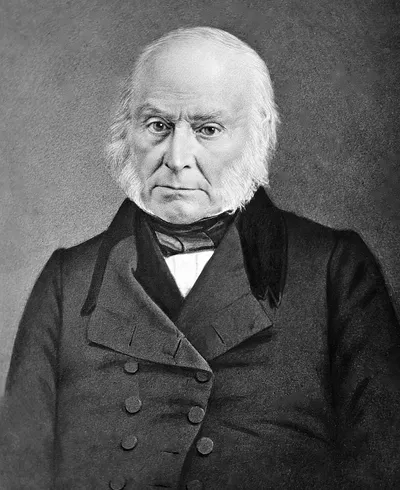
1825–1829 · 6th president
John Quincy Adams
In their own wordsIn 1824 no one won an Electoral College majority, so the House picked me, even though Andrew Jackson had more popular and electoral votes. When I named Henry Clay, who helped me win, as secretary of state, Jackson's backers called it a corrupt bargain. I proposed federal roads, canals, a national university, and even a national observatory, but Congress turned down most of it. I signed the 1828 tariff that Southern critics nicknamed the Tariff of Abominations. My political support stayed weak, and Jackson beat me decisively in 1828.
What they did
- Won the presidency in a House vote after the 1824 election produced no electoral majority
- Appointed Henry Clay secretary of state, prompting Jacksonian charges of a "corrupt bargain"
- Proposed federal roads, canals, a national university, and an observatory; Congress rejected most
- Signed the Tariff of 1828, which Southern critics called the "Tariff of Abominations"
How historians rank them
Ranked below all 5 presidents before them.
How popular they were
- Won 1824: 84 of 261 electoral votes, 32.7% of the popular vote
No scientific polls existed yet, so elections were the only measure of popularity.
What people called them
- "Old Man Eloquent" Gained currency from his antislavery fight as a congressman after his presidency and the Amistad case.
“Most importantly, Adams failed as a President principally because he was a poor politician in a day and age when politics had begun to matter more.”
Margaret A. Hogan, Miller Center, "John Quincy Adams: Impact and Legacy" (last updated 2023)
Expansion and civil war 1829–1876
- #7
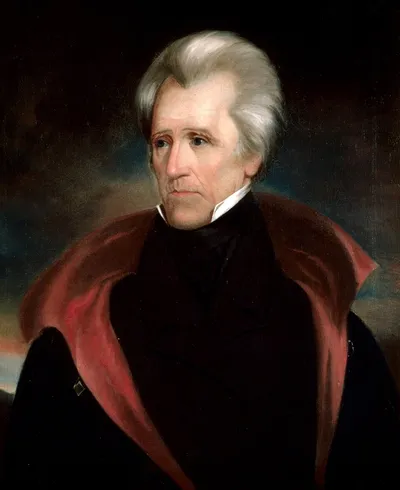
1829–1837 · 7th president
Andrew Jackson
In their own wordsI won in 1828 promising to take on what I saw as a corrupt elite. I replaced many federal workers with loyal supporters, which critics called the spoils system. I signed the Indian Removal Act in 1830, leading to the forced removal of tens of thousands of Native Americans, including the Cherokee, whose Trail of Tears followed in 1838. I vetoed the national bank's renewal and pulled federal money from it, and the Senate censured me. I faced down South Carolina's nullification of federal tariffs, paid off the national debt, and enslaved people throughout my life.
What they did
- Signed the Indian Removal Act (1830), leading to forced removal of Southeastern tribes, including the Cherokee
- Vetoed the recharter of the Second Bank of the United States (1832) and removed federal deposits
- Opposed South Carolina's nullification of federal tariffs; signed the Force Bill in 1833
- Censured by the Senate in 1834; paid off the national debt in 1835
How historians rank them
Ranked below all 6 presidents before them.
How popular they were
- Won 1828: 178 of 261 electoral votes, 55.3% of the popular vote
- Won 1832: 219 of 286 electoral votes, 54.2% of the popular vote
No scientific polls existed yet, so elections were the only measure of popularity.
What people called them
- "Old Hickory" Earned for his toughness leading his troops' hard march back to Nashville in 1813.
- "King Andrew the First" Used by opponents of his expanded executive power, including in an 1832 cartoon; they formed the Whig Party.
“Jackson's own character polarized contemporaries and continues to divide historians. Some praise his strength and audacity; others see him as vengeful and self-obsessed.”
Daniel Feller, Miller Center, "Andrew Jackson: Impact and Legacy" (last updated 2025) - #8
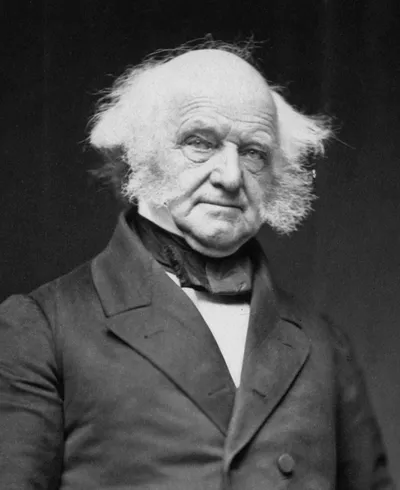
1837–1841 · 8th president
Martin Van Buren
In their own wordsSoon after I took office, the Panic of 1837 set off a depression that lasted for years. I didn't think the government should rescue banks, so I pushed for an independent Treasury to hold federal money, which Congress passed in 1840. My administration carried out the forced removal of the Cherokee known as the Trail of Tears, during which thousands died, and kept fighting the Second Seminole War. I opposed annexing Texas, partly to avoid a fight over slavery, and calmed border tensions with Britain. Voters blamed me for the economy, and I lost in 1840.
What they did
- The Panic of 1837 began weeks into his term, starting a severe, years-long depression
- Signed the Independent Treasury Act (1840), separating federal funds from private banks
- Carried out the Cherokee removal known as the Trail of Tears (1838–1839); continued the Second Seminole War
- Declined to annex Texas and defused border crises with Britain, including the Caroline affair
How historians rank them
Ranked below all 7 presidents before them.
How popular they were
- Won 1836: 170 of 294 electoral votes, 50.8% of the popular vote
No scientific polls existed yet, so elections were the only measure of popularity.
What people called them
- "Little Magician" Earned for his political skill as he rose in New York politics and the U.S. Senate.
- "Martin Van Ruin" Whig jab during the 1840 campaign, blaming him for the depression that followed the Panic of 1837.
“As president, Van Buren failed to address satisfactorily the economic depression that threw the nation into financial chaos.”
Mark Cheathem, Miller Center, "Martin Van Buren: Impact and Legacy" (last updated 2026) - #9
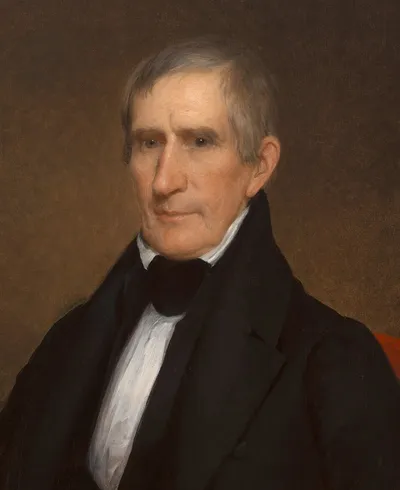
1841–1841 · 9th president
William Henry Harrison
In their own wordsI won in 1840 after a campaign that sold me as a log-cabin, hard-cider man of the people, even though I came from a wealthy Virginia planter family. At 68, I was the oldest president yet. I gave the longest inaugural address in history, 8,445 words that took nearly two hours, on a cold, wet day. I clashed with Henry Clay but eventually called Congress into a special session. I fell ill about three weeks after taking office and died on April 4, 1841, after just 31 days, the shortest presidency ever.
What they did
- Won the 1840 "log cabin and hard cider" campaign with the slogan "Tippecanoe and Tyler Too"
- Delivered the longest inaugural address in U.S. history, at 8,445 words
- Called Congress into a special session to address the nation's finances
- Died April 4, 1841, after 31 days, the first president to die in office
How historians rank them
Ranked below all 8 presidents before them.
How popular they were
- Won 1840: 234 of 294 electoral votes, 52.9% of the popular vote
No scientific polls existed yet, so elections were the only measure of popularity.
What people called them
- "Old Tippecanoe" From his 1811 victory at the Battle of Tippecanoe; revived in the 1840 slogan "Tippecanoe and Tyler Too."
“Harrison's significance in presidential history does not lie in his brief term in office, but rather in the innovative campaign techniques designed by his party to secure him the office.”
William Freehling, Miller Center, "William Harrison: Impact and Legacy" (last updated 2023) - #10
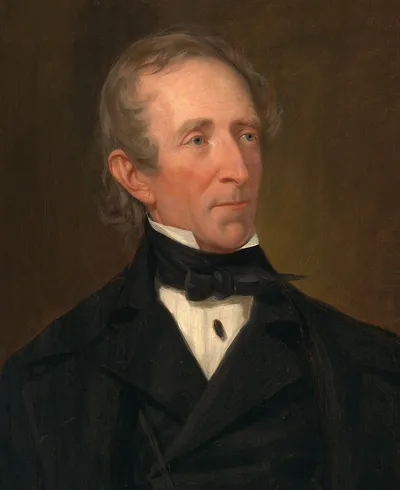
1841–1845 · 10th president
John Tyler
In their own wordsWhen Harrison died, I insisted I was the full president, not just an acting one, a precedent later written into the 25th Amendment. Then I vetoed my own Whig Party's bills for a national bank, so nearly my whole cabinet quit and the party expelled me. House Whigs started the first impeachment effort against a president, but it went nowhere. I signed the Webster–Ashburton Treaty settling the Maine border, opened trade with China, and pushed to annex Texas as a slave state, which Congress approved just before I left. I was also a slaveholder.
What they did
- Established that a vice president who succeeds becomes president in full (the "Tyler precedent")
- Vetoed Whig national bank bills; his cabinet resigned except Webster, and the Whigs expelled him
- Signed the Webster–Ashburton Treaty (1842) and the Treaty of Wanghia with China (1844)
- Signed the joint resolution to annex Texas; Congress overrode his veto for the first time
How historians rank them
Ranked above 1 of the 9 presidents before them.
How popular they were
Never elected president. Became president when William Henry Harrison died.
No scientific polls existed yet, so elections were the only measure of popularity.
What people called them
- "His Accidency" Mocking name from Whig opponents after he became president upon Harrison's death in 1841.
“Unfortunately, Tyler proved much better at taking over the presidency than at actually being President.”
William Freehling, Miller Center, "John Tyler: Impact and Legacy" (last updated 2023) - #11
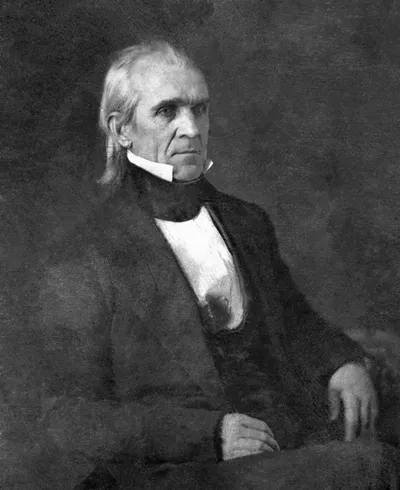
1845–1849 · 11th president
James K. Polk
In their own wordsI promised to serve one term and get big things done, and I mostly did. I signed the law making Texas a state, settled the Oregon border with Britain, and led the U.S. into war with Mexico in 1846 after a clash in land both countries claimed. The peace treaty added California and the Southwest. I also cut tariffs and set up an independent Treasury. Critics called the war a land grab, and the new territory reignited the fight over expanding slavery. I was a slaveholder and bought enslaved people while in office.
What they did
- Settled the Oregon boundary with Britain at the 49th parallel in the 1846 Oregon Treaty.
- Led the Mexican–American War; Mexico ceded California and the Southwest in the 1848 Treaty of Guadalupe Hidalgo.
- Signed the Walker Tariff lowering rates and re-created the Independent Treasury system in 1846.
- War gains sparked the Wilmot Proviso fight over slavery's expansion, deepening sectional divisions.
How historians rank them
Ranked above 4 of the 10 presidents before them.
How popular they were
- Won 1844: 170 of 275 electoral votes, 49.5% of the popular vote
No scientific polls existed yet, so elections were the only measure of popularity.
What people called them
- "Young Hickory" Used through much of his career, tying him to his mentor Andrew Jackson, "Old Hickory."
- "Napoleon of the Stump" Earned early in his Tennessee political career for his campaign speaking.
“Depending on whom one reads, Polk comes across as either a nearly great President or as a man who missed great opportunities. Clearly, his impact was significant.”
John C. Pinheiro, "James K. Polk: Impact and Legacy," Miller Center, University of Virginia (online essay) - #12
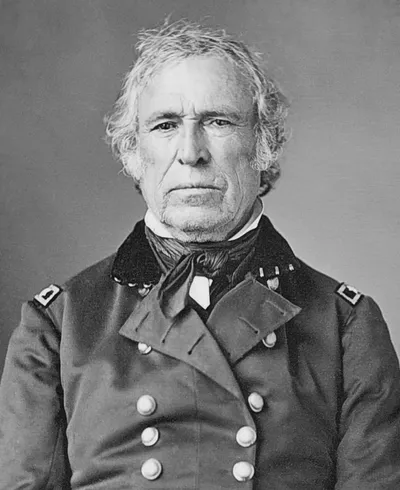
1849–1850 · 12th president
Zachary Taylor
In their own wordsI was a war hero with no political experience when the Whigs ran me in 1848. I owned enslaved people, but I pushed California and New Mexico to apply for statehood right away, which meant they would likely be free states. Southern leaders threatened secession, and I made clear I would use force to hold the Union together. I opposed Henry Clay's big compromise package. My administration signed the Clayton–Bulwer Treaty with Britain over a future Central American canal. I got sick and died after about 16 months in office.
What they did
- Pushed California and New Mexico to seek statehood directly, bypassing the territorial fight over slavery.
- Opposed Henry Clay's compromise proposals and threatened force against any Southern secession attempt.
- Signed the Clayton–Bulwer Treaty with Britain in 1850 concerning a future Central American canal.
- Died in office on July 9, 1850, after about 16 months as president.
How historians rank them
Ranked above 2 of the 11 presidents before them.
How popular they were
- Won 1848: 163 of 290 electoral votes, 47.3% of the popular vote
No scientific polls existed yet, so elections were the only measure of popularity.
What people called them
- "Old Rough and Ready" Earned during the Second Seminole War in the late 1830s; carried into his 1848 campaign.
“Zachary Taylor's presidency was too short-lived to have substantially impacted the office or the nation. He is not remembered as a great President.”
Michael Holt, "Zachary Taylor: Impact and Legacy," Miller Center, University of Virginia (online essay) - #13
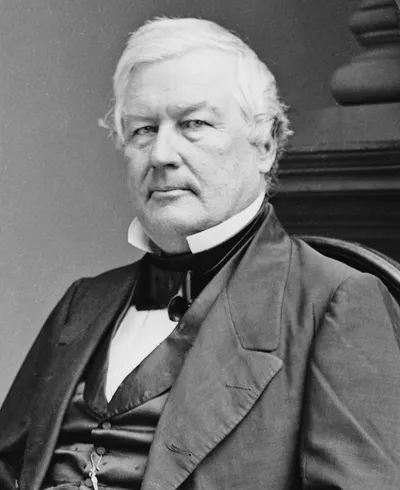
1850–1853 · 13th president
Millard Fillmore
In their own wordsI became president when Zachary Taylor died. Unlike him, I backed the Compromise of 1850, a set of laws that admitted California as a free state and ended the slave trade in Washington, D.C. It also included a much tougher Fugitive Slave Act, which I signed and enforced. It required people in free states to help capture those who had escaped slavery, and it made me deeply unpopular in the North. I sent Commodore Perry's expedition to open trade with Japan. My party passed me over in 1852, and I was the last Whig president.
What they did
- Signed the Compromise of 1850, admitting California as a free state and banning the slave trade in D.C.
- Signed and enforced the Fugitive Slave Act of 1850, provoking widespread anger in the North.
- Dispatched Commodore Matthew Perry's expedition to open trade relations with Japan.
- Denied the Whig nomination in 1852; he was the last Whig president.
How historians rank them
Ranked above 1 of the 12 presidents before them.
How popular they were
Never elected president. Became president when Zachary Taylor died.
No scientific polls existed yet, so elections were the only measure of popularity.
What people called them
- "The American Louis Philippe" Nickname comparing his dignified look and cautious style to France's King Louis Philippe.
“By championing the Compromise of 1850, he can be credited for keeping America from civil war for more than a decade. The political cost to himself, however, was total.”
Michael Holt, "Millard Fillmore: Impact and Legacy," Miller Center, University of Virginia (online essay) - #14
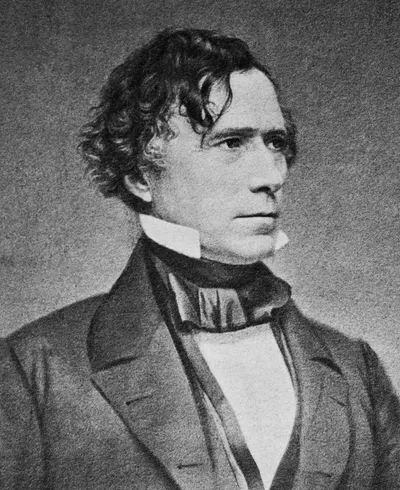
1853–1857 · 14th president
Franklin Pierce
In their own wordsI won in 1852 as a little-known dark horse who promised to calm the slavery debate. Instead, I signed the Kansas-Nebraska Act in 1854, which let settlers in those territories vote on whether to allow slavery. It wiped out the Missouri Compromise line and led to deadly fighting known as Bleeding Kansas. Anger over it helped launch the Republican Party. I completed the Gadsden Purchase from Mexico, but my diplomats' Ostend Manifesto, which pushed for taking Cuba, caused an uproar. My own party refused to renominate me in 1856.
What they did
- Signed the Kansas–Nebraska Act in 1854, repealing the Missouri Compromise line and triggering Bleeding Kansas violence.
- Completed the Gadsden Purchase from Mexico, adding land in present-day southern Arizona and New Mexico.
- The Ostend Manifesto, issued by his diplomats calling for acquiring Cuba, drew widespread criticism.
- Sought renomination in 1856, but Democrats chose James Buchanan instead.
How historians rank them
Ranked below all 13 presidents before them.
How popular they were
- Won 1852: 254 of 296 electoral votes, 50.8% of the popular vote
No scientific polls existed yet, so elections were the only measure of popularity.
What people called them
- "Young Hickory of the Granite Hills" Likened him to Andrew Jackson and his home state of New Hampshire.
- "Fainting Frank" Used by Whig opponents in the 1852 campaign to question his Mexican–American War record.
“For most historians, Pierce is viewed as an inept chief executive whose traditional style of leadership failed in the face of the massive electoral divisions over slavery and the aggressiveness of Southerners.”
Jean H. Baker, "Franklin Pierce: Impact and Legacy," Miller Center, University of Virginia (online essay) - #15
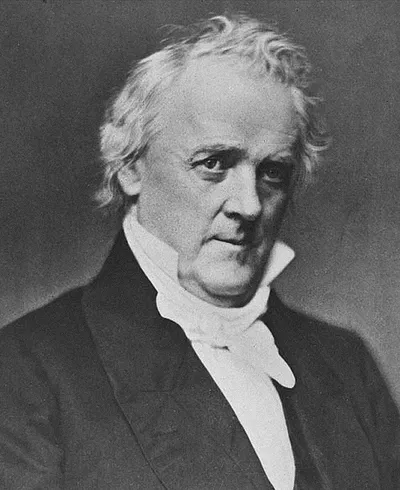
1857–1861 · 15th president
James Buchanan
In their own wordsI hoped to settle the fight over slavery, but it got worse on my watch. Right after I took office, the Supreme Court's Dred Scott decision said Black Americans could not be citizens, and I had privately pressed a justice to join the majority. I backed Kansas's proslavery Lecompton constitution, which split my Democratic Party. The Panic of 1857 hit the economy hard. After Lincoln won in 1860, Southern states began seceding. I said secession was illegal but that I lacked the power to stop it, leaving the crisis to my successor.
What they did
- Supported the 1857 Dred Scott decision after privately urging a justice to join the majority.
- Backed Kansas's proslavery Lecompton Constitution, splitting the Democratic Party.
- Faced the Panic of 1857, a financial crisis followed by an economic downturn.
- Called secession illegal but said he lacked power to stop it as seven states left.
How historians rank them
Ranked below all 14 presidents before them.
How popular they were
- Won 1856: 174 of 296 electoral votes, 45.3% of the popular vote
No scientific polls existed yet, so elections were the only measure of popularity.
What people called them
- "Ten-Cent Jimmy" Republican jab in the 1856 campaign after he said ten cents a day was fair pay for laborers.
- "Old Public Functionary" Press nickname for the aging, old-fashioned Buchanan; he used the phrase himself in 1859.
“By refusing to take a firm stand on either side of the slavery issue, Buchanan failed to resolve the question, leaving his nation's gravest crisis to his successor.”
William Cooper, "James Buchanan: Impact and Legacy," Miller Center, University of Virginia (online essay) - #16
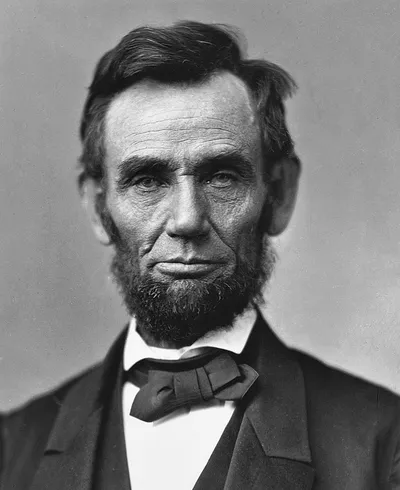
1861–1865 · 16th president
Abraham Lincoln
In their own wordsI won in 1860 without a single Southern electoral vote, and 11 states left the Union. I led the North through the Civil War, the deadliest war in U.S. history. In 1863 I issued the Emancipation Proclamation, and I pushed Congress to pass the 13th Amendment ending slavery. I also signed the Homestead Act and backed the transcontinental railroad. Critics attacked me for suspending habeas corpus and letting the military detain civilians without trial. I won reelection in 1864 but was assassinated in April 1865, days after Lee surrendered.
What they did
- Led the Union through the Civil War, ending with the main Confederate surrenders in spring 1865.
- Issued the Emancipation Proclamation in 1863 and pushed the 13th Amendment abolishing slavery through Congress.
- Signed the Homestead Act, Morrill Land-Grant College Act, and Pacific Railway Act in 1862.
- Suspended habeas corpus and allowed military arrests of civilians; assassinated in April 1865.
How historians rank them
Ranked above all 15 presidents before them.
How popular they were
- Won 1860: 180 of 303 electoral votes, 39.7% of the popular vote
- Won 1864: 212 of 233 electoral votes, 55% of the popular vote
No scientific polls existed yet, so elections were the only measure of popularity.
What people called them
- "Honest Abe" Popular nickname from his Illinois years, widely used during his 1860 campaign and presidency.
- "Rail-Splitter" Republicans promoted this frontier image of him during the 1860 campaign.
“No President in American history ever faced a greater crisis and no President ever accomplished as much.”
Michael Burlingame, "Abraham Lincoln: Impact and Legacy," Miller Center, University of Virginia (online essay) - #17
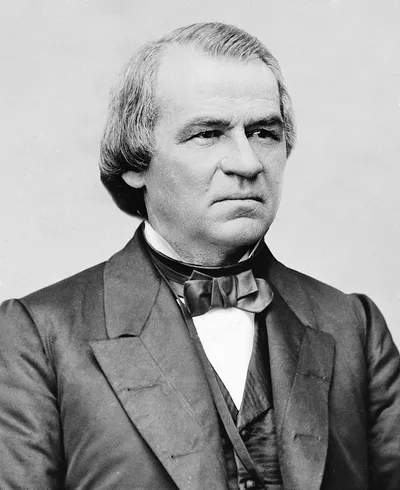
1865–1869 · 17th president
Andrew Johnson
In their own wordsI took over after Lincoln was assassinated. As a Southern Unionist, I let former Confederate states back in quickly with few conditions and pardoned many ex-Confederates. Those states then passed Black Codes restricting freed people. I vetoed civil rights and Freedmen's Bureau bills and opposed the 14th Amendment, so Congress overrode me and took control of Reconstruction. In 1868 the House impeached me after I fired War Secretary Edwin Stanton, and the Senate acquitted me by one vote. My administration also bought Alaska from Russia.
What they did
- Pursued lenient Reconstruction, pardoning many ex-Confederates as Southern states enacted restrictive Black Codes.
- Vetoed civil rights and Freedmen's Bureau bills; Congress overrode him and passed the Reconstruction Acts.
- Impeached by the House in 1868 after firing Edwin Stanton; acquitted by the Senate by one vote.
- Oversaw the purchase of Alaska from Russia in 1867.
How historians rank them
Ranked above 1 of the 16 presidents before them.
How popular they were
Never elected president. Became president when Abraham Lincoln was assassinated.
No scientific polls existed yet, so elections were the only measure of popularity.
What people called them
- "Sir Veto" Critics' label for his heavy use of the veto against Congress's Reconstruction bills, 1865–1869.
“For the most part, historians view Andrew Johnson as the worst possible person to have served as President at the end of the American Civil War.”
Elizabeth R. Varon, "Andrew Johnson: Impact and Legacy," Miller Center, University of Virginia (online essay) - #18
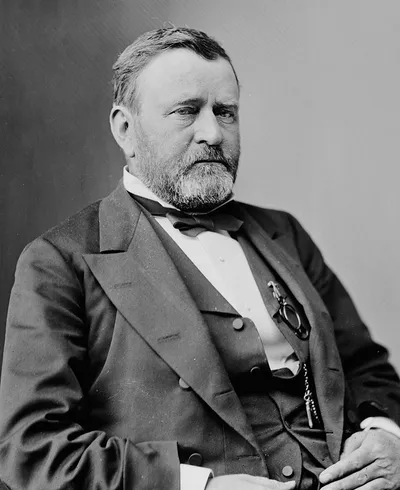
1869–1877 · 18th president
Ulysses S. Grant
In their own wordsI was the general who won the Civil War for the Union, and I served two terms. I backed the 15th Amendment protecting Black men's right to vote and used federal troops and prosecutors to break up the Ku Klux Klan. I signed the law creating the Justice Department and settled disputes with Britain through the Treaty of Washington. But my administration was hit by scandals like the Whiskey Ring, even though I was never personally implicated. The Panic of 1873 caused a long depression, and Northern support for Reconstruction faded.
What they did
- Supported ratification of the 15th Amendment in 1870, barring racial discrimination in voting.
- Enforced the Ku Klux Klan Act of 1871, using federal troops and prosecutors against Klan violence.
- Administration hit by scandals, including the Whiskey Ring and War Secretary William Belknap's impeachment.
- Settled the Alabama Claims through the 1871 Treaty of Washington; the Panic of 1873 began a depression.
How historians rank them
Ranked above 9 of the 17 presidents before them.
How popular they were
- Won 1868: 214 of 294 electoral votes, 52.7% of the popular vote
- Won 1872: 286 of 352 electoral votes, 55.6% of the popular vote
No scientific polls existed yet, so elections were the only measure of popularity.
What people called them
- "Unconditional Surrender Grant" Coined by the Northern press in 1862 after his demand at Fort Donelson, playing on his initials.
“He was a natural leader on the battlefield but was not an especially effective leader of his country. Still, in the areas of Native American policy, civil service reform, and African American rights, he took steps that few had attempted.”
Joan Waugh, "Ulysses S. Grant: Impact and Legacy," Miller Center, University of Virginia (online essay)
Gilded Age and progressives 1877–1928
- #19
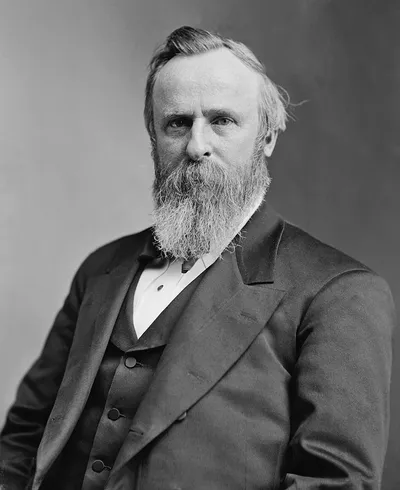
1877–1881 · 19th president
Rutherford B. Hayes
In their own wordsI won the disputed 1876 election by one electoral vote after a special commission gave me every contested state, even though Samuel Tilden won more popular votes. Under an informal deal called the Compromise of 1877, I pulled federal troops from Southern statehouses, which effectively ended Reconstruction and left Black voters there unprotected. During the Great Railroad Strike of 1877, I sent federal troops when governors asked for help. I pushed civil service reform, fought Senate bosses over appointments, and kept my promise to serve one term.
What they did
- Won the disputed 1876 election through an Electoral Commission despite losing the popular vote.
- Withdrew federal troops from Southern statehouses in 1877, effectively ending Reconstruction.
- Sent federal troops at governors' requests during the Great Railroad Strike of 1877.
- Pursued civil service reform, including removing Chester Arthur from the New York Customhouse.
How historians rank them
Ranked above 7 of the 18 presidents before them.
How popular they were
- Won 1876: 185 of 369 electoral votes, 47.9% of the popular vote
No scientific polls existed yet, so elections were the only measure of popularity.
What people called them
- "Rutherfraud" Used by Democrats who saw his 1876 election as illegitimate, throughout his term (1877–1881).
- "His Fraudulency" Another Democratic insult over the disputed 1876 election, used during his presidency.
“Hayes’s policies and politics were, ultimately, not up to preventing the coming of a new and bitter age of racial and economic inequality in late 19th-century America.”
Robert D. Johnston, "Rutherford B. Hayes: Impact and Legacy," Miller Center, University of Virginia (online essay) - #20
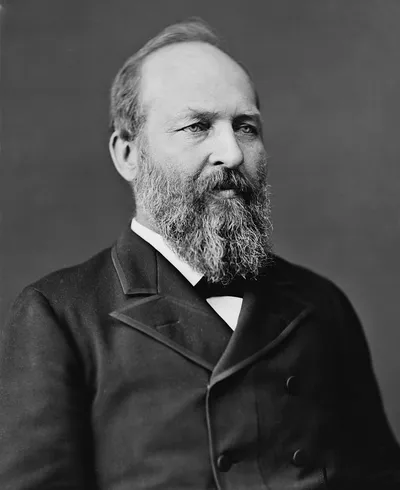
1881–1881 · 20th president
James A. Garfield
In their own wordsI was president for only about six and a half months. Early on, I fought New York Senator Roscoe Conkling over who controlled federal jobs in his state, and he ended up resigning in protest. I supported investigating the Star Route mail-contract fraud. In July 1881, Charles Guiteau, a disappointed office seeker, shot me at a Washington train station. I lived for about 11 weeks, but my doctors' unsterile probing likely made things worse, and I died in September. My death boosted the push for civil service reform.
What they did
- Clashed with Senator Roscoe Conkling over New York patronage; Conkling resigned from the Senate in protest.
- Backed an investigation into the Star Route postal contract fraud scandal.
- Shot by Charles Guiteau on July 2, 1881; died September 19 after about 200 days in office.
- His assassination fueled support for the Pendleton Civil Service Reform Act, passed in 1883.
How historians rank them
Ranked above 9 of the 19 presidents before them.
How popular they were
- Won 1880: 214 of 369 electoral votes, 48.3% of the popular vote
No scientific polls existed yet, so elections were the only measure of popularity.
What people called them
- "Boatman Jim" Nickname recalling his teenage job on Ohio canal boats, a story played up in his 1880 campaign.
“Murdered within months of his inauguration, Garfield served as President too briefly for him to have left much of an impact. Still, his legacy is far more ambiguous than most people realize.”
Justus Doenecke, "James A. Garfield: Impact and Legacy," Miller Center, University of Virginia (online essay) - #21
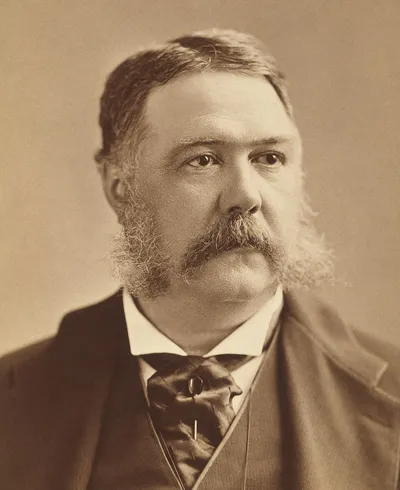
1881–1885 · 21st president
Chester A. Arthur
In their own wordsI became president after James Garfield was shot by a frustrated office-seeker. People expected me, a New York machine politician, to reward my cronies. Instead I signed the Pendleton Act in 1883, which started hiring some federal workers through merit exams. I backed building a modern steel Navy and vetoed a pricey rivers-and-harbors bill, though Congress overrode me. I signed the Chinese Exclusion Act, banning Chinese laborers for ten years, after vetoing a 20-year version. The Star Route fraud trials ended without convictions. Quietly sick with kidney disease, I lost my party's nomination in 1884.
What they did
- Signed the Pendleton Civil Service Reform Act (1883), creating merit-based hiring for some federal jobs
- Signed the Chinese Exclusion Act (1882) after vetoing an earlier 20-year ban
- Began construction of the first steel warships of the modern U.S. Navy
- Vetoed the 1882 Rivers and Harbors Act; Congress overrode the veto the next day
How historians rank them
Ranked above 7 of the 20 presidents before them.
How popular they were
Never elected president. Became president when James A. Garfield was assassinated.
No scientific polls existed yet, so elections were the only measure of popularity.
What people called them
- "Gentleman Boss" Nickname as the dapper leader of New York's Republican machine before his presidency
- "Dude President" Nickname poking fun at his fancy clothes and taste for luxury
“Historians view the Chester Arthur presidency as an important surprise, one that no one would have expected. Put simply, he performed well in office, defying his state-based reputation as a slick machine politician.”
Justus Doenecke, Miller Center, "Chester A. Arthur: Impact and Legacy" - #22
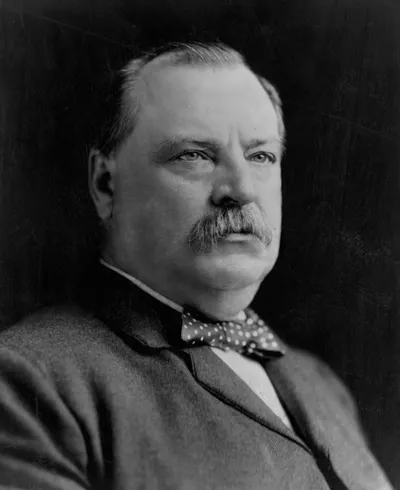
1885–1889 · 22nd president
Grover Cleveland
In their own wordsI was the first Democrat elected president since before the Civil War. In this term I vetoed 414 bills, more than four times as many as any earlier president, including hundreds of private pension bills for Civil War veterans and a drought-relief seed bill for Texas farmers. I signed the Interstate Commerce Act to regulate railroads, and the Dawes Act, which split up tribal lands and led to Native nations losing huge amounts of land. I pushed hard to lower tariffs, but the Senate blocked it. In 1888 I won the popular vote but lost the Electoral College.
What they did
- Vetoed 414 bills, including hundreds of private Civil War pension bills and the Texas Seed Bill
- Signed the Interstate Commerce Act (1887), creating a federal commission to regulate railroads
- Signed the Dawes Act (1887), dividing tribal lands into individual plots; Native landholdings shrank sharply
- Pushed for lower tariffs; lost 1888 reelection despite winning the popular vote
How historians rank them
Both terms are ranked together. Ranked above 11 of the 21 presidents before them.
How popular they were
- Won 1884: 219 of 401 electoral votes, 48.8% of the popular vote
No scientific polls existed yet, so elections were the only measure of popularity.
What people called them
- "His Obstinacy" Nickname for his stubbornness and record-setting number of vetoes
- "Grover the Good" Nickname reflecting his reputation for honesty and integrity in public office
“Although not a great President, Cleveland almost single-handedly restored and strengthened the power and autonomy of the executive branch.”
Henry F. Graff, Miller Center, "Grover Cleveland: Impact and Legacy" - #23
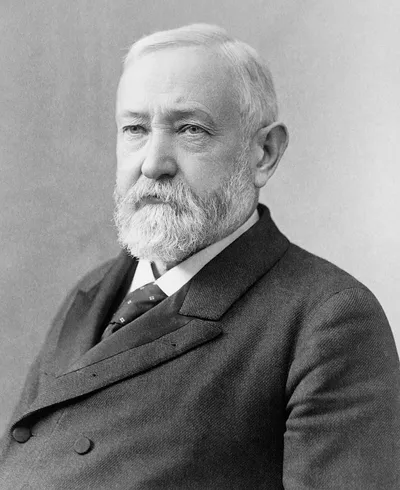
1889–1893 · 23rd president
Benjamin Harrison
In their own wordsI won in 1888 by carrying the Electoral College while losing the popular vote. With Republicans running Congress, I signed the Sherman Antitrust Act, the high McKinley Tariff, the Sherman Silver Purchase Act, and a big expansion of veterans' pensions. Six western states joined the Union, and I started the national forest reserves. I backed a bill to protect Black voting rights in the South, but the Senate killed it. The Army's massacre of Lakota people at Wounded Knee happened during my term. Voters turned on my party in 1890, and Cleveland beat me in 1892.
What they did
- Signed the Sherman Antitrust Act (1890), the first federal law against monopolies
- Signed the McKinley Tariff and Sherman Silver Purchase Act, later blamed partly for the Panic of 1893
- Admitted six states: North Dakota, South Dakota, Montana, Washington, Idaho, and Wyoming
- U.S. Army killed more than 250 Lakota at Wounded Knee in December 1890
How historians rank them
Ranked above 7 of the 22 presidents before them.
How popular they were
- Won 1888: 233 of 401 electoral votes, 47.8% of the popular vote
No scientific polls existed yet, so elections were the only measure of popularity.
What people called them
- "Centennial President" Called this because his 1889 inauguration marked 100 years since George Washington's first inauguration
- "Little Ben" Nickname used by Democrats of his era, referring to his short stature
“When compared with the Roosevelts, Wilson, and Truman—activist Presidents of the twentieth century, men who fought wars, managed empires, and confronted economic depressions—Harrison's ranking looks average. Few historians today, however, would judge him as mediocre or insignificant.”
Allan B. Spetter, Miller Center, "Benjamin Harrison: Impact and Legacy" - #24
1893–1897 · 24th president
Grover Cleveland
In their own wordsI came back after four years out, the first president to serve two non-consecutive terms, just as the Panic of 1893 set off a severe depression. I got Congress to repeal the Sherman Silver Purchase Act to protect gold reserves, which split my party. During the 1894 Pullman Strike I sent federal troops to Chicago, angering organized labor. I withdrew a treaty to annex Hawaii after finding U.S. involvement in overthrowing its queen. I also had secret surgery to remove a tumor from my jaw. In 1896 my own party rejected my policies and nominated William Jennings Bryan.
What they did
- Faced the Panic of 1893 and a deep depression; won repeal of the Sherman Silver Purchase Act
- Sent federal troops to Chicago during the 1894 Pullman Strike, over Illinois's governor's objections
- Withdrew Hawaii annexation treaty after an investigation found U.S. involvement in Queen Liliuokalani's overthrow
- Pressed Britain into arbitration over the Venezuela boundary dispute under a broad reading of the Monroe Doctrine
How historians rank them
Both terms are ranked together. Ranked above 12 of the 22 presidents before them.
How popular they were
- Won 1892: 277 of 444 electoral votes, 46% of the popular vote
No scientific polls existed yet, so elections were the only measure of popularity.
What people called them
- "Uncle Jumbo" Nickname referring to his weight, which reached around 280 pounds during his presidency
“On the other hand, his stubborn enmity toward the Silverites and agrarian populists nearly split the Democrats and contributed to their defeat in 1896.”
Henry F. Graff, Miller Center, "Grover Cleveland: Impact and Legacy" - #25
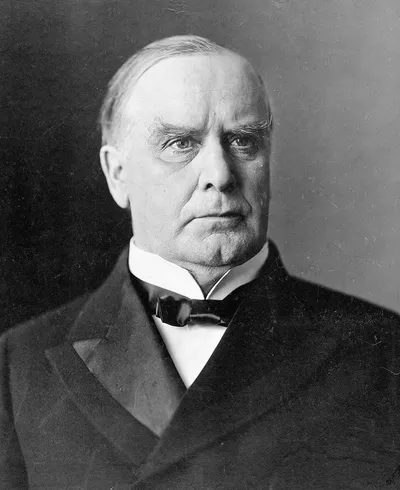
1897–1901 · 25th president
William McKinley
In their own wordsI won in 1896 promising high tariffs and gold-backed money, then signed the Dingley Tariff and the Gold Standard Act. After the USS Maine exploded in Havana, I tried diplomacy, then asked Congress for war with Spain in 1898. We won fast and took Puerto Rico, Guam, and the Philippines, and I annexed Hawaii. Filipinos seeking independence then fought U.S. troops in a long, deadly war. I refused to send federal help after the 1898 Wilmington coup against Black citizens. I won reelection in 1900 and was assassinated in Buffalo in 1901.
What they did
- Led the U.S. to victory in the 1898 Spanish–American War
- Acquired Puerto Rico, Guam, and the Philippines from Spain; annexed Hawaii
- Philippine–American War began in 1899 as U.S. forces fought Filipino independence fighters
- Signed Dingley Tariff (1897) and Gold Standard Act (1900); assassinated in Buffalo in September 1901
How historians rank them
Ranked above 14 of the 23 presidents before them.
How popular they were
- Won 1896: 271 of 447 electoral votes, 51% of the popular vote
- Won 1900: 292 of 447 electoral votes, 51.6% of the popular vote
No scientific polls existed yet, so elections were the only measure of popularity.
What people called them
- "The Napoleon of Protection" Nickname tied to his high-tariff stance, including the 1890 tariff he wrote in Congress
- "The Major" Nickname from the rank he held in the Union Army during the Civil War
“He did not reinvent the presidency, but he did work very successfully within the prevailing limitations and conception of the office.”
Lewis L. Gould, Miller Center, "William McKinley: Impact and Legacy" - #26
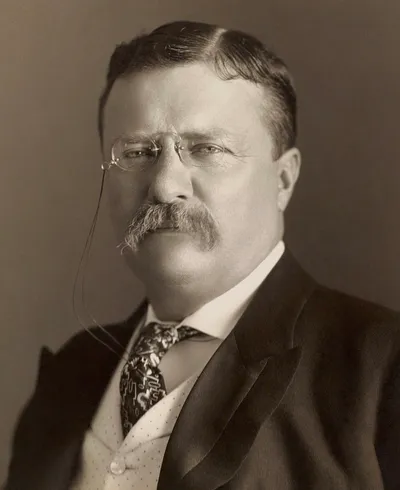
1901–1909 · 26th president
Theodore Roosevelt
In their own wordsI took over at 42 after McKinley was killed, the youngest president ever. I sued to break up the Northern Securities railroad trust, pushed a settlement in the 1902 coal strike, and signed laws for meat inspection, pure food and drugs, and railroad rate regulation. I put about 230 million acres under public protection. I backed Panama's break from Colombia to build the canal and claimed a right to police Latin America. I won a Nobel Peace Prize for brokering an end to the Russo-Japanese War. I also dishonorably discharged three companies of Black soldiers after the Brownsville affair.
What they did
- Revived antitrust enforcement, starting with the Northern Securities case, and mediated the 1902 coal strike
- Signed the Pure Food and Drug Act, Meat Inspection Act, and Hepburn Act (1906)
- Placed about 230 million acres under federal protection, including national forests and monuments
- Backed Panama's 1903 independence from Colombia to secure the canal; announced the Roosevelt Corollary (1904)
How historians rank them
Ranked above 22 of the 24 presidents before them.
How popular they were
- Won 1904: 336 of 476 electoral votes, 56.4% of the popular vote
No scientific polls existed yet, so elections were the only measure of popularity.
What people called them
- "The Trust Buster" Nickname earned through his antitrust lawsuits against big business combinations
- "Teddy" Used in The New York Times by 1900; Roosevelt himself disliked the nickname
“Theodore Roosevelt is widely regarded as the first modern President of the United States. The stature and influence that the office has today began to develop with TR.”
Sidney Milkis, Miller Center, "Theodore Roosevelt: Impact and Legacy" - #27
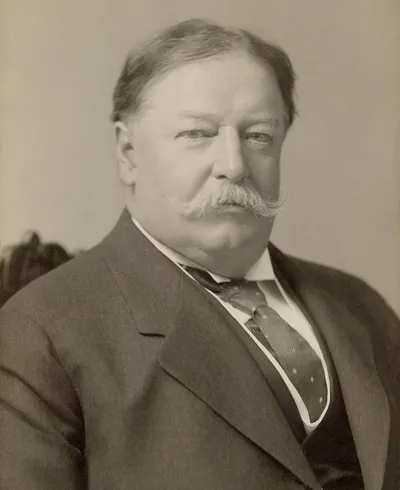
1909–1913 · 27th president
William Howard Taft
In their own wordsI was Theodore Roosevelt's hand-picked successor. My Justice Department brought about 70 antitrust cases in four years, and the Supreme Court broke up Standard Oil in 1911. Congress sent the income tax amendment to the states, and I set up postal savings banks. But the Payne–Aldrich Tariff I signed barely cut rates, and firing forester Gifford Pinchot made progressives furious. My Dollar Diplomacy pushed U.S. investment abroad, especially in Latin America. Roosevelt ran against me in 1912, splitting Republicans; I finished third and won just two states.
What they did
- Brought about 70 antitrust cases; Supreme Court broke up Standard Oil and American Tobacco (1911)
- Signed the Payne–Aldrich Tariff (1909), angering progressives who wanted deeper rate cuts
- Fired Gifford Pinchot in the Ballinger–Pinchot conservation dispute (1910), deepening the Republican split
- Congress proposed the 16th (income tax) and 17th (direct Senate election) Amendments; Arizona, New Mexico admitted
How historians rank them
Ranked above 13 of the 25 presidents before them.
How popular they were
- Won 1908: 321 of 483 electoral votes, 51.6% of the popular vote
No scientific polls existed yet, so elections were the only measure of popularity.
What people called them
- "Big Bill" Nickname referring to his size; he weighed over 300 pounds during his presidency
“Although the word "disaster" is perhaps too extreme, there can be no doubt that Taft's hesitancy as a leader and politician produced few accomplishments during his term.”
Peri E. Arnold, Miller Center, "William Taft: Impact and Legacy" - #28
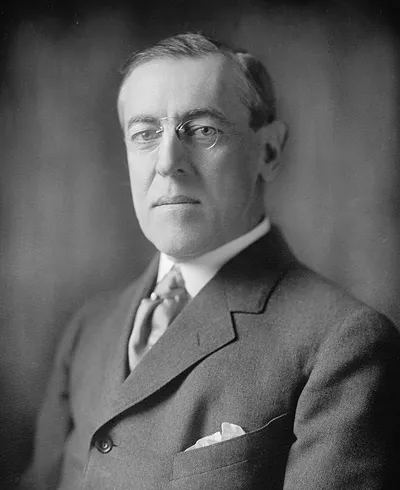
1913–1921 · 28th president
Woodrow Wilson
In their own wordsI won in 1912 when Republicans split. My first term brought lower tariffs, a federal income tax, the Federal Reserve, the Clayton Antitrust Act, and the Federal Trade Commission. I also authorized segregation in federal offices. I won in 1916 partly for keeping us out of World War I, then asked for war in 1917 after German submarine attacks. The Espionage and Sedition Acts were used to prosecute critics. I pushed my Fourteen Points and a League of Nations, but the Senate rejected the peace treaty. A 1919 stroke left me seriously disabled for the rest of my term.
What they did
- Signed the Federal Reserve Act (1913), Federal Trade Commission Act, and Clayton Antitrust Act (1914)
- Authorized racial segregation in federal government departments
- Led the U.S. into World War I (1917); Espionage and Sedition Acts used to prosecute critics
- Senate rejected the Treaty of Versailles and League of Nations; 19th Amendment ratified in 1920
How historians rank them
Ranked above 21 of the 26 presidents before them.
How popular they were
- Won 1912: 435 of 531 electoral votes, 41.8% of the popular vote
- Won 1916: 277 of 531 electoral votes, 49.2% of the popular vote
No scientific polls existed yet, so elections were the only measure of popularity.
What people called them
- "The Schoolmaster" Nickname for the bespectacled former Princeton professor who tended to lecture his visitors
- "Coiner of Weasel Words" Jab at Wilson by former president Theodore Roosevelt in a speech
“When legacy is defined as influence on the nation and future politics, Wilson ranks behind only Washington, Lincoln, Franklin Roosevelt, and Jefferson in importance.”
Saladin Ambar, Miller Center, "Woodrow Wilson: Impact and Legacy" - #29
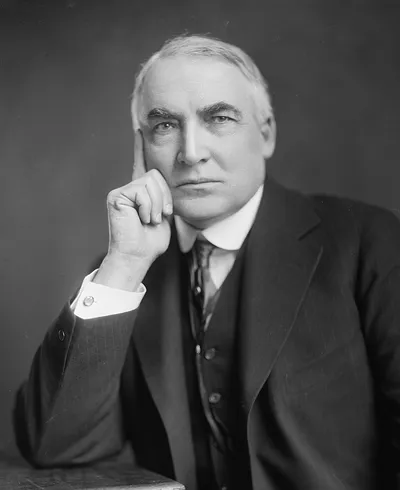
1921–1923 · 29th president
Warren G. Harding
In their own wordsI won a 1920 landslide promising a return to normalcy after World War I. I signed tax cuts, created the federal budget bureau, and hosted the Washington Naval Conference to limit warships. I freed Socialist Eugene Debs from prison and spoke in Alabama for Black political equality, though the anti-lynching bill I supported died in the Senate. I signed laws restricting immigration and raising tariffs. Some friends I appointed were corrupt, and the Veterans' Bureau and Teapot Dome oil-lease scandals came to light around my death in office in 1923.
What they did
- Hosted the Washington Naval Conference (1921–22), producing a major naval arms limitation treaty
- Signed the Budget and Accounting Act (1921) and tax cuts; raised tariffs with Fordney–McCumber (1922)
- Commuted Eugene Debs's prison sentence; supported a federal anti-lynching bill that Senate Democrats filibustered
- Administration scandals, including Teapot Dome and the Veterans' Bureau, led to prison terms for appointees
How historians rank them
Ranked above 4 of the 27 presidents before them.
How popular they were
- Won 1920: 404 of 531 electoral votes, 60.3% of the popular vote
No scientific polls existed yet, so elections were the only measure of popularity.
What people called them
- "Wobbly Warren" Nickname for his flip-flopping and reliance on his cabinet during important events
“Most historians rank Harding as the worst of all American Presidents. Recently, some revisionists see him as an important transitional figure whose easy-going ways helped bridge the gap between Wilsonian idealism and the business prosperity of the Coolidge and Hoover years.”
Eugene P. Trani, Miller Center, "Warren G. Harding: Impact and Legacy" - #30
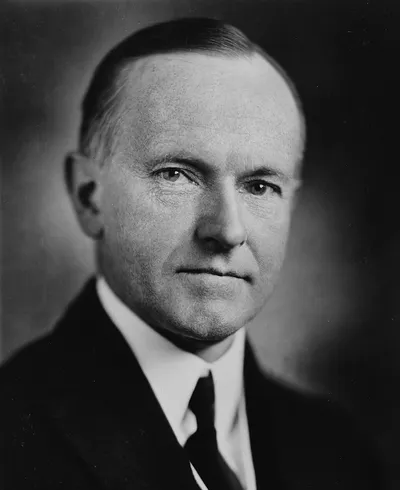
1923–1929 · 30th president
Calvin Coolidge
In their own wordsMy father, a notary, swore me in by kerosene lamp after Harding died in 1923, and I worked to restore trust after his scandals. I won in 1924 and pushed tax cuts, tight spending, and budget surpluses during a booming economy. I signed the Indian Citizenship Act and the Immigration Act of 1924, which set national-origin quotas and shut out Japanese immigrants, a part I objected to. I vetoed farm relief bills twice and kept federal help limited after the 1927 Mississippi flood. I chose not to run in 1928.
What they did
- Signed the Revenue Acts of 1924 and 1926, cutting income taxes; the federal budget ran surpluses
- Signed the Indian Citizenship Act and the Immigration Act of 1924 with national-origin quotas
- Vetoed McNary–Haugen farm relief bills (1927, 1928); criticized for limited 1927 Mississippi flood response
- His administration negotiated the Kellogg–Briand Pact (1928), renouncing war as an instrument of national policy
How historians rank them
Ranked above 12 of the 28 presidents before them.
How popular they were
- Won 1924: 382 of 531 electoral votes, 54% of the popular vote
No scientific polls existed yet, so elections were the only measure of popularity.
What people called them
- "Silent Cal" Nickname for his quiet, dry personality; the legend took off during his vice presidency
- "Cool Cal" Tied to his 1924 reelection campaign slogan, Keep It Cool With Coolidge
“Despite his personal integrity, he offered no sweeping vision or program of action that the presidencies of Theodore Roosevelt and Woodrow Wilson had led the public to associate with presidential greatness.”
David Greenberg, Miller Center, "Calvin Coolidge: Impact and Legacy"
Depression to Watergate 1929–1976
- #31
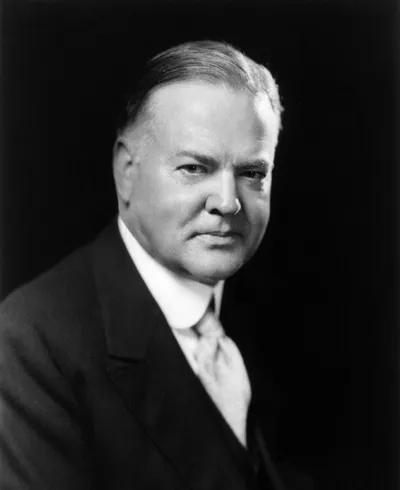
1929–1933 · 31st president
Herbert Hoover
In their own wordsI took office in March 1929, and seven months later the stock market crashed, kicking off the Great Depression. I pushed business leaders to keep wages up, backed public works like what became Hoover Dam, and created the Reconstruction Finance Corporation to lend money to banks and railroads. But I opposed direct federal relief payments to struggling people, and I signed the Smoot-Hawley Tariff, which led other countries to retaliate. In 1932, troops I sent in drove the Bonus Army of protesting veterans out of Washington. With unemployment soaring, I lost reelection in a landslide.
What they did
- Stock market crash of October 1929 began the Great Depression seven months into his term.
- Signed the Smoot-Hawley Tariff Act (1930), raising import duties and prompting retaliation from trading partners.
- Created the Reconstruction Finance Corporation (1932) to lend federal money to banks, railroads, and other businesses.
- Army troops forcibly removed the Bonus Army of protesting World War I veterans from Washington in 1932.
How historians rank them
Ranked above 7 of the 29 presidents before them.
How popular they were
- Won 1928: 444 of 531 electoral votes, 58.1% of the popular vote
No scientific polls existed yet, so elections were the only measure of popularity.
What people called them
- "Hoovervilles" Critics' name for Depression-era shantytowns of homeless people in the 1930s; term coined by Charles Michelson.
“What emerges, then, for Hoover is a mixed and perhaps still damning verdict, but one that takes a more accurate measure of the President, his policies, and his politics.”
David E. Hamilton, "Herbert Hoover: Impact and Legacy," Miller Center, University of Virginia - #32
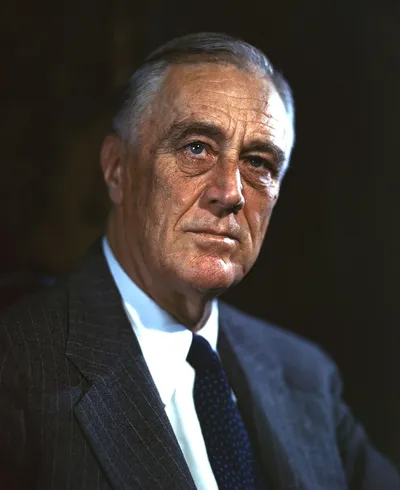
1933–1945 · 32nd president
Franklin D. Roosevelt
In their own wordsI was elected four times and served 12 years, longer than any other president. During the Great Depression I launched the New Deal: banking reforms, Social Security, legal protection for unions, and job programs like the WPA and CCC. Unemployment fell but stayed high until World War II. My 1937 plan to add justices to the Supreme Court failed in Congress. After Pearl Harbor, I led the U.S. into World War II alongside the Allies. I also signed Executive Order 9066, which led to the forced incarceration of about 120,000 Japanese Americans. I died in office in April 1945.
What they did
- Launched the New Deal, including Social Security, the WPA, FDIC deposit insurance, and union rights under the Wagner Act.
- Proposed adding up to six Supreme Court justices in 1937; Congress rejected the plan.
- Led the U.S. through World War II after Japan's December 7, 1941, attack on Pearl Harbor.
- Signed Executive Order 9066 (1942), leading to the incarceration of about 120,000 Japanese Americans.
How historians rank them
Ranked above 29 of the 30 presidents before them.
How popular they were
72% average approval across 20 polls. High 83% (Jan 1942), low 65% (Jul 1941); 65% when leaving office.
Gallup's surviving data for FDR covers 1941–1943 only.
The first president Gallup polled.
- Won 1932: 472 of 531 electoral votes, 57.4% of the popular vote
- Won 1936: 523 of 531 electoral votes, 60.8% of the popular vote
- Won 1940: 449 of 531 electoral votes, 54.7% of the popular vote
- Won 1944: 432 of 531 electoral votes, 53.4% of the popular vote
What people called them
- "Fireside chats" Name coined by CBS executive Harry C. Butcher for Roosevelt's radio addresses to the nation, 1933–1944.
- "Court-packing plan" Critics' label for Roosevelt's 1937 bill to add Supreme Court justices; phrase coined by Edward Rumely.
“He may have done more during those twelve years to change American society and politics than any of his predecessors in the White House, save Abraham Lincoln.”
William E. Leuchtenburg, "Franklin D. Roosevelt: Impact and Legacy," Miller Center, University of Virginia - #33
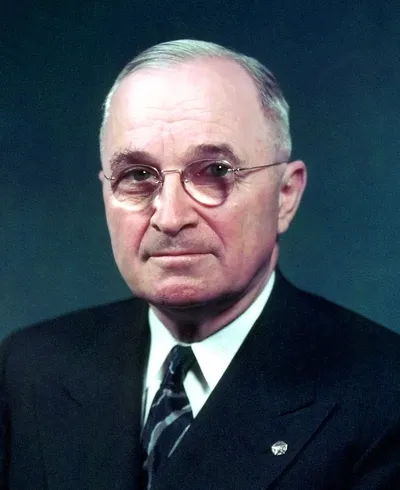
1945–1953 · 33rd president
Harry S. Truman
In their own wordsI became president when FDR died in April 1945, weeks before Germany surrendered. I decided to drop atomic bombs on Hiroshima and Nagasaki, and Japan surrendered soon after. To contain Soviet communism, I backed the Truman Doctrine, the Marshall Plan to rebuild Europe, the Berlin Airlift, and NATO. In 1948 I ordered the armed forces desegregated and won a reelection almost nobody predicted. In 1950 I sent troops to Korea; the war stalled, and I fired General MacArthur for defying me. Korea and corruption charges in my administration left me deeply unpopular when I left office.
What they did
- Ordered atomic bombings of Hiroshima and Nagasaki in August 1945; Japan soon surrendered, ending World War II.
- Adopted Cold War containment: Truman Doctrine, Marshall Plan, Berlin Airlift, and NATO's founding in 1949.
- Issued Executive Order 9981 (1948), ending segregation in the U.S. armed forces.
- Committed U.S. troops to the Korean War in 1950 and fired General Douglas MacArthur in 1951.
How historians rank them
Ranked above 26 of the 31 presidents before them.
How popular they were
42% average approval across 68 polls. High 87% (Jun 1945), low 22% (Feb 1952); 32% when leaving office.
Lower average approval than Franklin D. Roosevelt, the only president polled before.
- Won 1948: 303 of 531 electoral votes, 49.5% of the popular vote
What people called them
- "Give 'em hell, Harry" Slogan shouted by crowds at stops on Truman's 1948 whistle-stop campaign tour.
- "Dewey Defeats Truman" Erroneous Chicago Daily Tribune banner headline the day after Truman's 1948 upset win.
“Viewed in this context, Truman's achievements in both foreign and domestic affairs, where he confronted some of the most difficult challenges any American president has faced, appear even more significant.”
Alonzo L. Hamby, "Harry S. Truman: Impact and Legacy," Miller Center, University of Virginia - #34
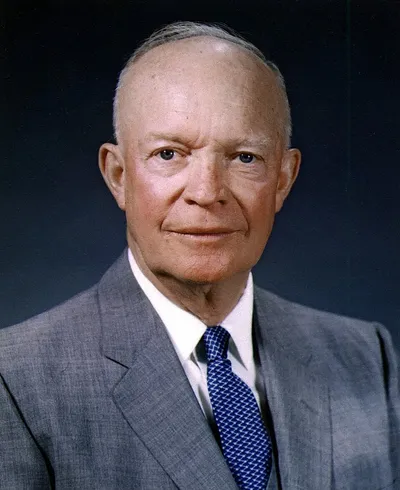
1953–1961 · 34th president
Dwight D. Eisenhower
In their own wordsI was the World War II general who won the White House in 1952. Six months in, I reached an armistice that stopped the fighting in Korea. I signed the law creating the Interstate Highway System, and after the Soviets launched Sputnik, I created NASA. I sent federal troops to Little Rock to enforce school desegregation and signed civil rights acts in 1957 and 1960, though critics say I moved too slowly on civil rights. I also authorized CIA-backed coups in Iran and Guatemala, and in 1960 a U.S. spy plane shot down over the Soviet Union embarrassed my administration.
What they did
- Reached a Korean War armistice in July 1953, ending active fighting.
- Signed the Federal-Aid Highway Act of 1956, creating the Interstate Highway System.
- Sent federal troops to enforce school desegregation in Little Rock, Arkansas, in 1957.
- Authorized CIA covert operations that helped overthrow governments in Iran (1953) and Guatemala (1954).
How historians rank them
Ranked above 26 of the 32 presidents before them.
How popular they were
65% average approval across 119 polls. High 79% (Dec 1956), low 48% (Mar 1958); 59% when leaving office.
Higher average approval than 1 of the 2 terms polled before.
- Won 1952: 442 of 531 electoral votes, 55.2% of the popular vote
- Won 1956: 457 of 531 electoral votes, 57.4% of the popular vote
What people called them
- "I Like Ike" Eisenhower's 1952 campaign slogan, featured on buttons and in televised ads.
- "do-nothing" Critics in the 1950s scorned Eisenhower as a "do-nothing" president, per historian Chester J. Pach Jr.
“Eisenhower, in short, achieved both important successes, but he sometimes fell short of his most cherished objectives. He left office a popular President, and his stature has grown with the passage of time.”
Chester J. Pach Jr., "Dwight D. Eisenhower: Impact and Legacy," Miller Center, University of Virginia - #35
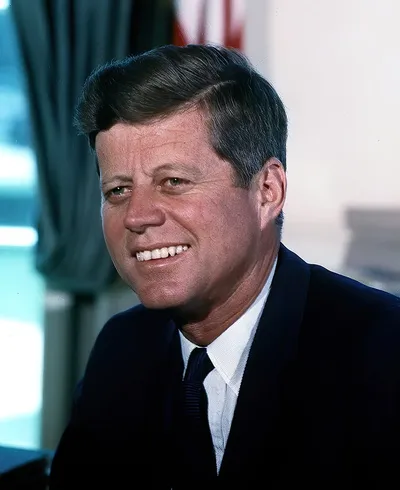
1961–1963 · 35th president
John F. Kennedy
In their own wordsAt 43, I was the youngest person ever elected president and the first Catholic president. Early on, the CIA-planned Bay of Pigs invasion of Cuba failed. In 1962, the Cuban Missile Crisis brought the world close to nuclear war before the Soviets agreed to remove their missiles. I launched the Peace Corps, set the goal of landing on the Moon, and signed a treaty limiting nuclear tests. I raised the number of U.S. military advisers in Vietnam to about 16,000. I proposed a major civil rights bill, but it hadn't passed when I was assassinated in Dallas in November 1963.
What they did
- Failed Bay of Pigs invasion of Cuba by CIA-trained Cuban exiles in April 1961.
- Cuban Missile Crisis (October 1962) ended with Soviet withdrawal of nuclear missiles from Cuba.
- Created the Peace Corps, set the Moon-landing goal, and signed the 1963 Limited Test Ban Treaty.
- Expanded U.S. military advisers in South Vietnam to about 16,000; assassinated in Dallas on November 22, 1963.
How historians rank them
Ranked above 26 of the 33 presidents before them.
How popular they were
71% average approval across 40 polls. High 82% (Apr 1961), low 56% (Sep 1963); 58% when leaving office.
Higher average approval than 2 of the 3 terms polled before.
- Won 1960: 303 of 537 electoral votes, 49.7% of the popular vote
What people called them
- "New Frontier" Kennedy's label for his agenda, introduced in his July 1960 Democratic convention acceptance speech.
- "Camelot" Jacqueline Kennedy evoked the musical Camelot in an interview after his death; the term came to describe his presidency.
“John F. Kennedy had promised much but never had the opportunity to see his program through. It was, in the words of one notable biographer, “an unfinished life.” For that reason, assessments of the Kennedy presidency remain mixed.”
Marc J. Selverstone, "John F. Kennedy: Impact and Legacy," Miller Center, University of Virginia - #36
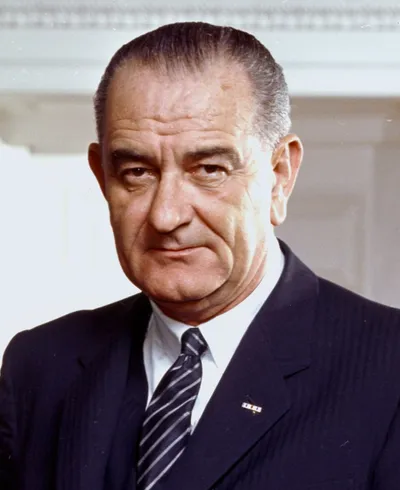
1963–1969 · 36th president
Lyndon B. Johnson
In their own wordsI became president when JFK was assassinated in 1963, then won a landslide in 1964. I signed the Civil Rights Act of 1964 and the Voting Rights Act of 1965, and launched my Great Society and War on Poverty, which created Medicare, Medicaid, and Head Start. But I also escalated the Vietnam War after the Gulf of Tonkin Resolution, raising U.S. troop levels above 500,000. As casualties climbed, antiwar protests grew and many Americans stopped trusting what my administration said about the war. In March 1968, I announced I would not run for reelection.
What they did
- Signed the Civil Rights Act of 1964 and the Voting Rights Act of 1965.
- Launched Great Society programs including Medicare, Medicaid, Head Start, and the War on Poverty.
- Escalated the Vietnam War after the 1964 Gulf of Tonkin Resolution; U.S. troops exceeded 500,000 by 1968.
- Amid antiwar opposition and a primary challenge, announced in March 1968 he would not seek reelection.
How historians rank them
Ranked above 26 of the 34 presidents before them.
How popular they were
56% average approval across 83 polls. High 79% (Feb 1964), low 35% (Aug 1968); 49% when leaving office.
Higher average approval than 1 of the 4 terms polled before.
- Won 1964: 486 of 538 electoral votes, 61.1% of the popular vote
What people called them
- "Great Society" Johnson's name for his domestic agenda, laid out in a 1964 speech at the University of Michigan.
- "Credibility gap" Press and critics' term from 1965 on for public skepticism of Johnson's statements about Vietnam.
“The legacies of death, renewal, and opportunity attached to the Johnson administration are ironic, confusing, and contested.”
Nancy Beck Young, "Lyndon B. Johnson: Impact and Legacy," Miller Center, University of Virginia - #37
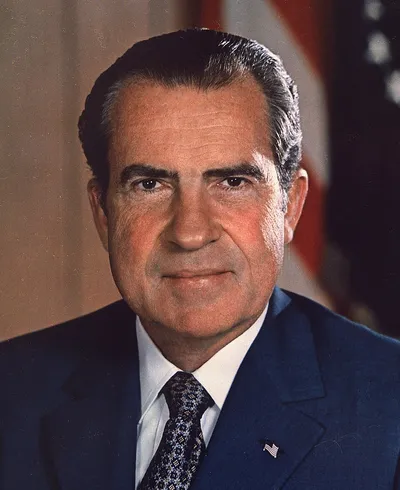
1969–1974 · 37th president
Richard Nixon
In their own wordsI won in 1968 promising law and order and an end to the Vietnam War. I gradually brought U.S. troops home but also expanded the war into Cambodia and Laos; a peace deal came in 1973. I visited China, signed arms control deals with the Soviet Union, created the EPA, and ended the draft. Then people working for my reelection campaign broke into Democratic headquarters at the Watergate, and I took part in covering it up. After my secret White House tapes proved it, I resigned in August 1974, facing likely impeachment. I'm the only president ever to resign.
What they did
- Gradually withdrew U.S. troops from Vietnam while expanding bombing; Paris Peace Accords signed January 1973.
- Visited China in 1972 and signed SALT I arms limitation agreements with the Soviet Union.
- Created the Environmental Protection Agency (1970) and imposed wage and price controls (1971).
- Resigned August 9, 1974, over the Watergate scandal, facing likely impeachment and removal.
How historians rank them
Ranked above 11 of the 35 presidents before them.
How popular they were
48% average approval across 95 polls. High 67% (Nov 1969), low 24% (Jul 1974); 24% when leaving office.
Higher average approval than 1 of the 5 terms polled before.
- Won 1968: 301 of 538 electoral votes, 43.4% of the popular vote
- Won 1972: 520 of 538 electoral votes, 60.7% of the popular vote
What people called them
- "Silent majority" Nixon's term for Americans not protesting the Vietnam War, from his November 3, 1969, televised address.
- "Saturday Night Massacre" Name for October 20, 1973, when Nixon ordered Watergate prosecutor Archibald Cox fired and top officials resigned.
“Nixon intended his presidency to be epochal and, despite being cut short by Watergate, it was.”
Ken Hughes, "Richard Nixon: Impact and Legacy," Miller Center, University of Virginia - #38
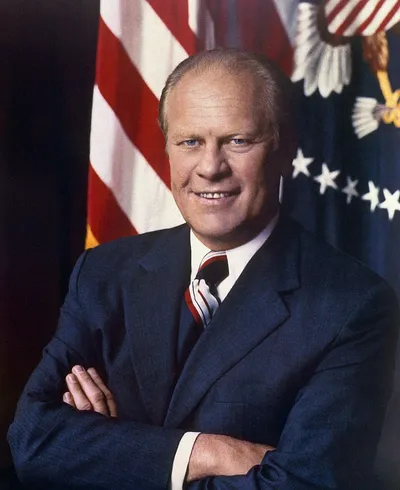
1974–1977 · 38th president
Gerald Ford
In their own wordsI'm the only president who was never elected president or vice president. Nixon appointed me vice president after Spiro Agnew resigned, and I took over when Nixon resigned in 1974. A month later I pardoned Nixon, a hugely controversial move that sank my popularity. I fought high inflation and a recession, and my Whip Inflation Now campaign was widely mocked. Saigon fell to North Vietnam in 1975 as the U.S. evacuated. I signed the Helsinki Accords and survived two assassination attempts in 1975. I narrowly lost the 1976 election to Jimmy Carter.
What they did
- Granted Richard Nixon a full and unconditional pardon in September 1974.
- Faced recession and high inflation; launched the voluntary Whip Inflation Now campaign in 1974.
- Oversaw the U.S. evacuation as Saigon fell to North Vietnamese forces in April 1975.
- Signed the Helsinki Final Act (1975) with 34 other nations, including the Soviet Union.
How historians rank them
Ranked above 15 of the 36 presidents before them.
How popular they were
47% average approval across 36 polls. High 71% (Aug 1974), low 37% (Jan 1975); 53% when leaving office.
Higher average approval than 1 of the 6 terms polled before.
Never elected president. Became president when Richard Nixon resigned.
What people called them
- "Our long national nightmare is over" Ford's own words on taking office in August 1974, referring to Watergate.
- "Whip Inflation Now" Ford's 1974 public campaign against inflation, known for its "WIN" buttons.
“Gerald Ford's presidency must be assessed in light of both the exceptional circumstances under which Ford assumed office and the severe challenges he faced during those years.”
John Robert Greene, "Gerald Ford: Impact and Legacy," Miller Center, University of Virginia
The modern presidency 1977–today
- #39
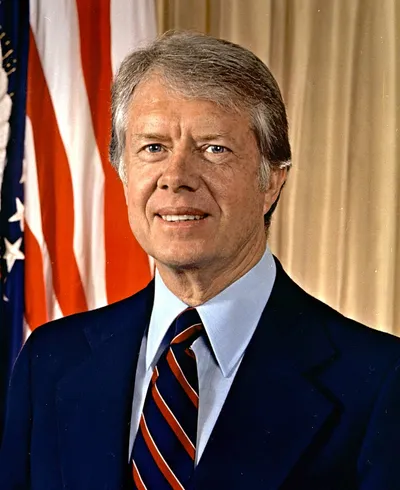
1977–1981 · 39th president
Jimmy Carter
In their own wordsI ran as a Washington outsider after Watergate. I brokered the Camp David Accords, which led to a lasting Egypt–Israel peace treaty, established full diplomatic relations with China, signed treaties returning the Panama Canal to Panama, and created the Departments of Energy and Education. I made human rights central to foreign policy. But inflation hit double digits and an energy crisis brought long gas lines. After Iranian militants seized the U.S. embassy in 1979, a rescue mission failed, and 52 Americans were held for 444 days. I lost the 1980 election to Ronald Reagan.
What they did
- Brokered the 1978 Camp David Accords, leading to the 1979 Egypt–Israel peace treaty.
- Established full diplomatic relations with China and signed treaties transferring the Panama Canal to Panama.
- Faced double-digit inflation, energy shortages, and gasoline lines; created the Department of Energy.
- Iran hostage crisis: 52 Americans held 444 days; a 1980 military rescue mission failed.
How historians rank them
Ranked above 18 of the 37 presidents before them.
How popular they were
47% average approval across 91 polls. High 75% (Mar 1977), low 28% (Jun 1979); 34% when leaving office.
Higher average approval than 1 of the 7 terms polled before.
- Won 1976: 297 of 538 electoral votes, 50.1% of the popular vote
What people called them
- "malaise speech" Label later given to Carter's July 1979 televised address on a national "crisis of confidence."
“His presidency was tumultuous but consequential and set the stage for a more centrist Democratic Party that would emerge in the 1990s and compete successfully in close elections in the new century.”
Robert A. Strong, "Jimmy Carter: Impact and Legacy," Miller Center, University of Virginia - #40
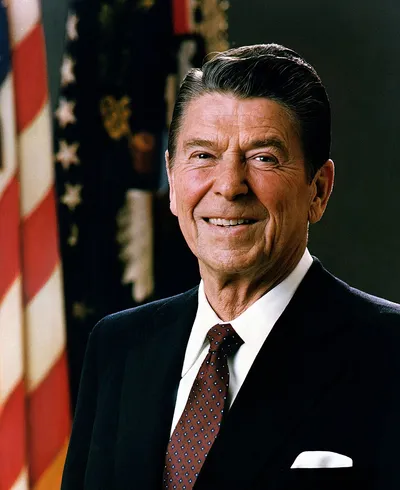
1981–1989 · 40th president
Ronald Reagan
In their own wordsI cut income tax rates hard and paid for a huge military buildup to pressure the Soviet Union. After a rough 1981–82 recession, inflation fell and the economy boomed, but the national debt nearly tripled. I survived being shot in 1981, fired striking air traffic controllers, and signed a 1986 law giving legal status to nearly 3 million undocumented immigrants. My aides secretly sold arms to Iran and sent the profits to Nicaragua's Contra rebels, which became the Iran–Contra scandal. With Gorbachev, I signed a treaty scrapping a whole class of nuclear missiles.
What they did
- Cut income taxes in 1981 and 1986; top rate fell from 70% to 28% as deficits soared.
- Survived a 1981 assassination attempt; fired over 11,000 striking air traffic controllers.
- Iran–Contra affair: secret arms sales to Iran funded Nicaraguan Contra rebels despite a congressional ban.
- Signed the 1987 INF Treaty with Gorbachev, eliminating an entire class of nuclear missiles.
How historians rank them
Ranked above 26 of the 38 presidents before them.
How popular they were
52% average approval across 135 polls. High 68% (May 1981), low 35% (Jan 1983); 63% when leaving office.
Higher average approval than 4 of the 8 terms polled before.
- Won 1980: 489 of 538 electoral votes, 50.7% of the popular vote
- Won 1984: 525 of 538 electoral votes, 58.8% of the popular vote
What people called them
- "The Great Communicator" Widely used by press and admirers in the 1980s for his skill explaining issues in plain terms.
- "Teflon President" Coined by Democratic Rep. Pat Schroeder in 1983; scandals seemed not to stick to him.
“Ronald Wilson Reagan was a transformational President. His leadership and the symbiotic relationship he forged with Soviet leader Mikhail Gorbachev during their four summit meetings set the stage for a peaceful resolution of the Cold War.”
Lou Cannon, Miller Center (University of Virginia), "Ronald Reagan: Impact and Legacy" (online essay, accessed 2026) - #41
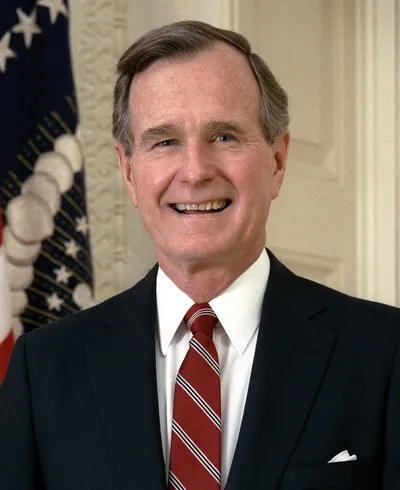
1989–1993 · 41st president
George H. W. Bush
In their own wordsI was president when the Berlin Wall fell, Germany reunified, and the Soviet Union broke apart, and I tried not to gloat so things stayed peaceful. I sent troops into Panama to capture Manuel Noriega, then built a big international coalition that pushed Iraq out of Kuwait in the 1991 Gulf War. At home I signed the Americans with Disabilities Act and stronger clean air rules. But I broke my campaign pledge of no new taxes in a 1990 budget deal, a recession hit, I pardoned six Iran–Contra figures, and I lost reelection in 1992.
What they did
- Led a broad international coalition that expelled Iraqi forces from Kuwait in the 1991 Gulf War.
- Oversaw end of Cold War: Berlin Wall's fall, German reunification, and the Soviet Union's 1991 collapse.
- Signed the Americans with Disabilities Act and Clean Air Act Amendments, both in 1990.
- Broke his no-new-taxes pledge in a 1990 budget deal; recession helped cost him reelection in 1992.
How historians rank them
Ranked above 21 of the 39 presidents before them.
How popular they were
61% average approval across 113 polls. High 89% (Feb 1991), low 29% (Jul 1992); 56% when leaving office.
Higher average approval than 6 of the 9 terms polled before.
- Won 1988: 426 of 538 electoral votes, 53.4% of the popular vote
What people called them
- "Read my lips: no new taxes" His 1988 convention pledge; critics and voters threw it back at him after the 1990 tax deal.
- "New world order" Bush's own phrase in 1990–91 for post–Cold War cooperation, widely used to describe his foreign policy.
“Generally the Bush presidency is viewed as successful in foreign affairs but a disappointment in domestic affairs. In the minds of voters, his achievements in foreign policy were not enough to overshadow the economic recession, and in 1992, the American public voted for change.”
Stephen Knott, Miller Center (University of Virginia), "George H. W. Bush: Impact and Legacy" (online essay, accessed 2026) - #42
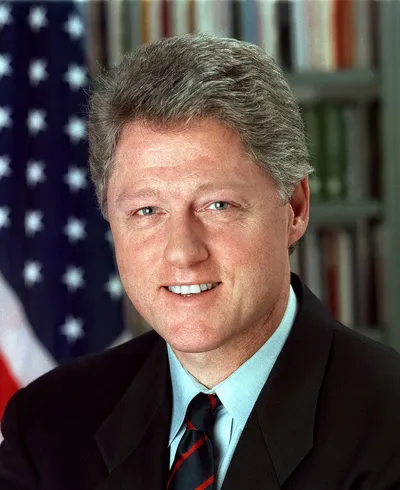
1993–2001 · 42nd president
Bill Clinton
In their own wordsI signed a 1993 budget that raised taxes on top earners, and during a long economic boom the federal budget hit its first surplus since 1969. I signed NAFTA, family and medical leave, a tough 1994 crime bill, and welfare reform. My big health care plan failed, and Republicans took Congress in 1994. I used NATO airpower to help end wars in Bosnia and Kosovo, but the U.S. did not act to stop the 1994 Rwandan genocide. Over my affair with Monica Lewinsky, the House impeached me for perjury and obstruction; the Senate acquitted me.
What they did
- 1993 budget raised top tax rates; the federal budget ran surpluses from 1998 through 2001.
- Signed NAFTA, the 1994 crime bill, and 1996 welfare reform; his universal health care plan failed.
- Led NATO interventions in Bosnia and Kosovo; U.S. did not intervene in Rwanda's 1994 genocide.
- Impeached by the House in 1998 over the Lewinsky affair; acquitted by the Senate in 1999.
How historians rank them
Ranked above 26 of the 40 presidents before them.
How popular they were
55% average approval across 216 polls. High 73% (Dec 1998), low 37% (Jun 1993); 66% when leaving office.
Higher average approval than 5 of the 10 terms polled before.
- Won 1992: 370 of 538 electoral votes, 43% of the popular vote
- Won 1996: 379 of 538 electoral votes, 49.2% of the popular vote
What people called them
- "The Comeback Kid" Press label from the 1992 New Hampshire primary, revived repeatedly during his presidency after political setbacks.
- "The first black president" Novelist Toni Morrison's description of Clinton in a 1998 New Yorker essay.
“Future historians will likely evaluate not just what Clinton did, but also what he did not accomplish, because he was tied-up in a second-term struggle for political survival.”
Russell L. Riley, Miller Center (University of Virginia), "Bill Clinton: Impact and Legacy" (online essay, accessed 2026) - #43
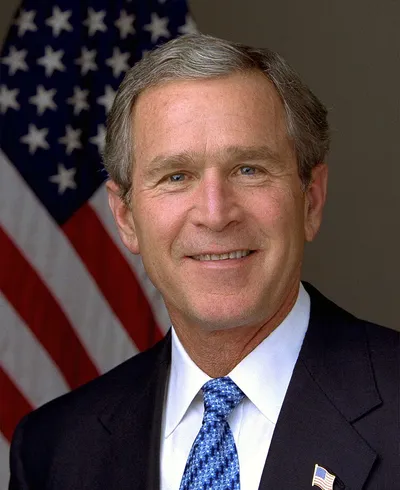
2001–2009 · 43rd president
George W. Bush
In their own wordsEight months in, the 9/11 attacks killed nearly 3,000 people, and I launched the war in Afghanistan. In 2003 I invaded Iraq, saying it had weapons of mass destruction; none were found, and the war dragged on for years. I created the Department of Homeland Security and signed the Patriot Act, big tax cuts, No Child Left Behind, and Medicare drug coverage, and started PEPFAR to fight AIDS in Africa. I was criticized over harsh interrogations widely called torture, the Hurricane Katrina response, and rising deficits. I left office amid the 2008 financial crisis after signing a bank bailout.
What they did
- Responded to 9/11 by launching the Afghanistan war, creating Homeland Security, and signing the Patriot Act.
- Invaded Iraq in 2003 citing weapons of mass destruction that were never found.
- Signed 2001 and 2003 tax cuts, No Child Left Behind, Medicare Part D; launched PEPFAR.
- Criticized over Katrina response and interrogation methods; signed TARP bank bailout in 2008 financial crisis.
How historians rank them
Ranked above 10 of the 41 presidents before them.
How popular they were
51% average approval across 282 polls. High 90% (Sep 2001), low 25% (Oct 2008); 34% when leaving office.
Higher average approval than 4 of the 11 terms polled before.
- Won 2000: 271 of 538 electoral votes, 47.9% of the popular vote
- Won 2004: 286 of 538 electoral votes, 50.7% of the popular vote
What people called them
- "Dubya" Popular nickname from his middle initial "W," widely used by press and public during his presidency.
- "Mission Accomplished" Banner behind Bush's May 2003 speech on Iraq; critics later cited it as premature as fighting continued.
“Arguably his greatest moment as President was his initial, heartfelt response to the tragedy of the 9/11 attacks. Soon, however, his administration was overshadowed by the wars in Afghanistan and Iraq.”
Gary L. Gregg II, Miller Center (University of Virginia), "George W. Bush: Impact and Legacy" (online essay, accessed 2026) - #44
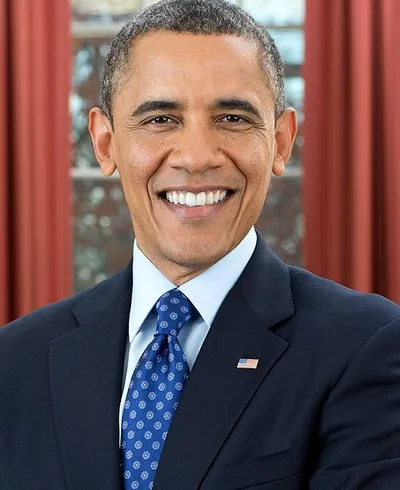
2009–2017 · 44th president
Barack Obama
In their own wordsI became the first Black president in the middle of the Great Recession and signed a $787 billion stimulus plus a rescue of GM and Chrysler. I signed the Affordable Care Act, which expanded health coverage to millions, and new Wall Street rules. I ordered the raid that killed Osama bin Laden, joined the Paris climate agreement, and made the Iran nuclear deal. Critics pointed to a slow recovery, the botched HealthCare.gov launch, expanded drone strikes, ISIS rising after U.S. troops left Iraq, and Guantánamo staying open. After Republicans won Congress, I leaned on executive actions like DACA.
What they did
- Signed $787 billion stimulus and auto industry rescue during the Great Recession.
- Signed the Affordable Care Act (2010) and Dodd–Frank financial reform; HealthCare.gov's 2013 launch failed badly.
- Ordered 2011 raid killing Osama bin Laden; left Iraq in 2011, then returned forces against ISIS in 2014.
- Joined Paris climate agreement and Iran nuclear deal; created DACA by executive action.
How historians rank them
Ranked above 33 of the 42 presidents before them.
How popular they were
48% average approval across 418 polls. High 67% (Jan 2009), low 40% (Aug 2011); 59% when leaving office.
Higher average approval than 3 of the 12 terms polled before.
- Won 2008: 365 of 538 electoral votes, 52.9% of the popular vote
- Won 2012: 332 of 538 electoral votes, 51.1% of the popular vote
What people called them
- "Obamacare" Coined by opponents as a pejorative for the Affordable Care Act; Obama later embraced the term.
“Obama’s lasting impact on American life may turn out to have been greatest in terms of the crises that did not happen. Despite teetering on the edge of economic catastrophe, the nation did not fall into the abyss of a second Great Depression in 2009.”
Michael Nelson, Miller Center (University of Virginia), "Barack Obama: Impact and Legacy" (online essay, 2018) - #45
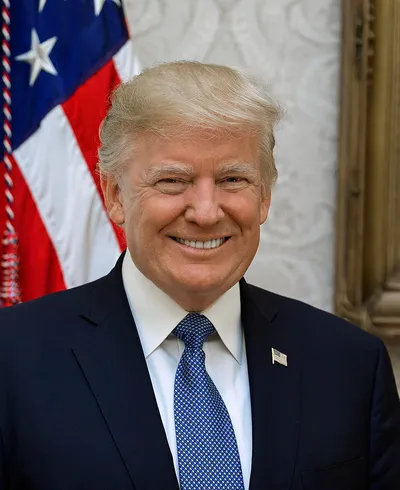
2017–2021 · 45th president
Donald Trump
In their own wordsI signed the Tax Cuts and Jobs Act, put three justices on the Supreme Court, and signed the First Step Act on criminal justice. I swapped NAFTA for the USMCA, launched a tariff war with China, quit the Paris climate and Iran nuclear deals, and brokered the Abraham Accords. My travel ban and border family separations drew fierce backlash. In 2020, Operation Warp Speed sped up COVID-19 vaccines, but my pandemic response was widely criticized. I was impeached twice, over Ukraine and after the January 6 Capitol attack that followed my false stolen-election claims. The Senate acquitted me both times.
What they did
- Signed 2017 Tax Cuts and Jobs Act; appointed Justices Gorsuch, Kavanaugh, and Barrett.
- Started trade war with China; replaced NAFTA with USMCA; brokered the Abraham Accords.
- COVID-19 pandemic: Operation Warp Speed backed vaccines; federal response widely criticized; 2020 economy plunged.
- Impeached twice, over Ukraine and the January 6 Capitol attack; acquitted both times by the Senate.
How historians rank them
Both terms are ranked together. Ranked above 2 of the 43 presidents before them.
How popular they were
40% average approval across 141 polls. High 49% (Jan 2020), low 34% (Jan 2021); 34% when leaving office.
Lower average approval than all 13 terms polled before.
- Won 2016: 304 of 538 electoral votes, 46.1% of the popular vote
What people called them
- "Make America Great Again" Trump's campaign slogan, used throughout his first term; its acronym MAGA came to name his movement.
- "America First" Trump's own label for his foreign and trade policy, declared in his 2017 inaugural address.
“Trump, who prided himself on his independence and unique approach to politics, routinely violated political norms.”
Benjamin C. Waterhouse, Miller Center (University of Virginia), "Donald Trump: Impact and Legacy" (online essay, 2024, updated 2026) - #46
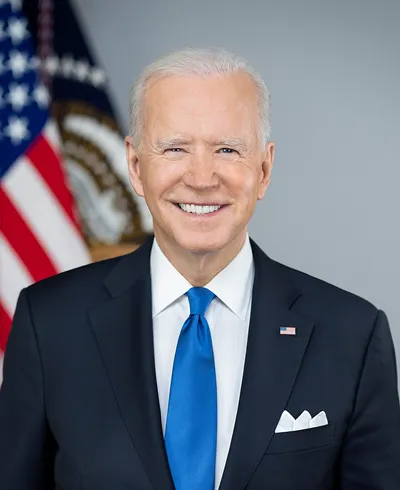
2021–2025 · 46th president
Joe Biden
In their own wordsI took office mid-pandemic and signed the $1.9 trillion American Rescue Plan as vaccines rolled out. I signed a bipartisan infrastructure law, the CHIPS Act, the Inflation Reduction Act with major climate spending, and the first big gun safety law in decades, and I put Ketanji Brown Jackson on the Supreme Court. But inflation hit a 40-year high in 2022, my 2021 Afghanistan withdrawal was chaotic and 13 U.S. troops died in a bombing, and border crossings hit records. I rallied allies behind Ukraine, dropped out of the 2024 race after a rough debate, and pardoned my son Hunter.
What they did
- Signed American Rescue Plan, bipartisan infrastructure law, CHIPS Act, and Inflation Reduction Act.
- Chaotic 2021 Afghanistan withdrawal; Kabul airport bombing killed 13 U.S. service members.
- Inflation peaked at 9.1% in 2022; record southern border encounters strained the immigration system.
- Led Western support for Ukraine after Russia's 2022 invasion; quit 2024 race after a poor debate.
How historians rank them
Ranked above 28 of the 44 presidents before them.
How popular they were
42% average approval across 50 polls. High 57% (Jan 2021), low 36% (Jul 2024); 40% when leaving office.
Higher average approval than 1 of the 14 terms polled before.
- Won 2020: 306 of 538 electoral votes, 51.3% of the popular vote
What people called them
- "Bidenomics" Media label for his economic agenda that Biden and the White House embraced in 2023.
- "Dark Brandon" Internet meme portraying Biden as a powerful figure, embraced by his staff and 2024 campaign.
“Yet, his infusion of government money into an economy stalled by the pandemic sparked inflation that hit Americans’ budgets so hard that many never credited him with improving the country’s financial outlook.”
Barbara A. Perry, Miller Center (University of Virginia), "Joe Biden: Impact and Legacy" (online essay, 2025) - #47
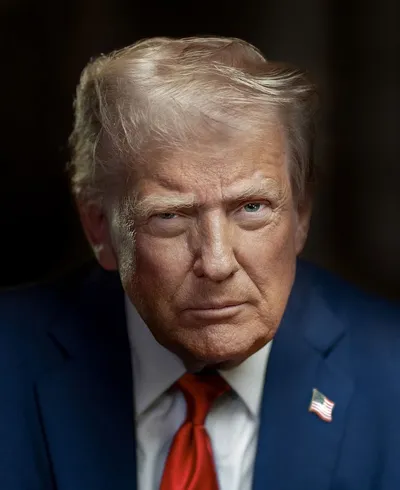
2025–today · 47th president
Donald Trump
In their own wordsI started with a record burst of executive orders, launched DOGE to cut federal jobs and agencies, and started mass deportations. I signed the One Big Beautiful Bill Act, extending my 2017 tax cuts while cutting Medicaid and adding trillions to projected deficits. My sweeping tariffs rattled markets; in February 2026 the Supreme Court struck down my emergency tariffs. I helped broker a 2025 Gaza ceasefire, ordered the capture of Venezuela's Nicolás Maduro, and launched a war on Iran with Israel that spiked oil prices. Courts have blocked many moves, and in November 2026 Democrats won both houses of Congress.
What they did
- Signed One Big Beautiful Bill Act: extended 2017 tax cuts, cut Medicaid, expanded immigration enforcement funding.
- DOGE layoffs, mass deportations, and National Guard city deployments; courts ruled many actions unlawful.
- Imposed sweeping tariffs; Supreme Court struck down his emergency-power (IEEPA) tariffs in February 2026.
- Brokered 2025 Gaza ceasefire; captured Venezuela's Maduro; launched U.S.–Israel war on Iran in February 2026.
How historians rank them
Surveys so far rate the first term. Ranked above 2 of the 44 presidents before them.
How popular they were
37% average approval across 59 polls. High 47% (Jan 2025), low 29% (Oct 2026); 31% in the latest poll (Oct 2026).
Lower average approval than all 15 terms polled before.
- Won 2024: 312 of 538 electoral votes, 49.8% of the popular vote
What people called them
- "Liberation Day" Trump's name for April 2, 2025, when he announced sweeping tariffs on nearly all trading partners.
- "One Big Beautiful Bill" Trump's name for his 2025 tax-and-spending law, signed July 4, 2025.
No president matches that search.
Sources
- Historian rankings: the C-SPAN Presidential Historians Survey (2021), the Siena College Research Institute survey (2022) and the Presidential Greatness Project survey of APSA members (2024), as compiled by Wikipedia. Presidents with two nonconsecutive terms are ranked once.
- Approval: Gallup polls compiled by the American Presidency Project at UC Santa Barbara. Trump's second term uses the Project's table: Gallup through December 2025, then other national polls of all adults after Gallup stopped measuring approval.
- Election results: Wikipedia's article on each presidential election.
- Records, nicknames and historian quotes: each links to its source; most come from the Miller Center at the University of Virginia and Wikipedia.
- Portraits: Wikimedia Commons, public domain or free-licensed. Credits.
Portrait credits
- George Washington (1789–1797): Gilbert Stuart, Public domain
- John Adams (1797–1801): Gilbert Stuart, CC0
- Thomas Jefferson (1801–1809): Rembrandt Peale, Public domain
- James Madison (1809–1817): John Vanderlyn, Public domain
- James Monroe (1817–1825): Samuel Finley Breese Morse, Public domain
- John Quincy Adams (1825–1829): Mathew Brady, Public domain
- Andrew Jackson (1829–1837): Ralph Eleaser Whiteside Earl, Public domain
- Martin Van Buren (1837–1841): Mathew Benjamin Brady, Public domain
- William Henry Harrison (1841–1841): Albert Gallatin Hoit, Public domain
- John Tyler (1841–1845): George Peter Alexander Healy, Public domain
- James K. Polk (1845–1849): James_Polk.jpg: Brady, Mathew B., 1823 (ca.)-1896, photographer. derivative work: Superwikifan (talk), Public domain
- Zachary Taylor (1849–1850): Zachary_Taylor_half_plate_daguerreotype_c1843-45.png: unknown, possibly Maguire of New Orleans derivative work: Beao, Public domain
- Millard Fillmore (1850–1853): Mathew Benjamin Brady, Public domain
- Franklin Pierce (1853–1857): Mathew Benjamin Brady / Adam Cuerden, Public domain
- James Buchanan (1857–1861): From Brady daguerreotype (Mathew Brady) (1822-1896), Public domain
- Abraham Lincoln (1861–1865): Alexander Gardner, Public domain
- Andrew Johnson (1865–1869): Mathew Benjamin Brady, Public domain
- Ulysses S. Grant (1869–1877): Brady-Handy Photograph Collection, Library of Congress, Public domain
- Rutherford B. Hayes (1877–1881): Mathew Benjamin Brady, Public domain
- James A. Garfield (1881–1881): Unknown; part of Brady-Handy Photograph Collection., Public domain
- Chester A. Arthur (1881–1885): Abraham Bogardus / Adam Cuerden, Public domain
- Grover Cleveland (1885–1889): Napoleon Sarony, Public domain
- Benjamin Harrison (1889–1893): Adam Cuerden, Public domain
- Grover Cleveland (1893–1897): Napoleon Sarony, Public domain
- William McKinley (1897–1901): Unknown author, Public domain
- Theodore Roosevelt (1901–1909): Adam Cuerden, Public domain
- William Howard Taft (1909–1913): Pach Brothers, restored by Adam Cuerden, Public domain
- Woodrow Wilson (1913–1921): Harris & Ewing, photographer, Public domain
- Warren G. Harding (1921–1923): Harris & Ewing, photographer, Public domain
- Calvin Coolidge (1923–1929): Harris & Ewing, Public domain
- Herbert Hoover (1929–1933): Underwood & Underwood, Public domain
- Franklin D. Roosevelt (1933–1945): Leon Perskie, CC BY 2.0
- Harry S. Truman (1945–1953): National Archives and Records Administration. Office of Presidential Libraries. Harry S. Truman Library., Public domain
- Dwight D. Eisenhower (1953–1961): White House, Public domain
- John F. Kennedy (1961–1963): Cecil W. Stoughton, Public domain
- Lyndon B. Johnson (1963–1969): Arnold Newman, Public domain
- Richard Nixon (1969–1974): Department of Defense. Department of the Army. Office of the Deputy Chief of Staff for Operations. U.S. Army Audiovisual Center. (ca. 1974 - 05/15/1984), Public domain
- Gerald Ford (1974–1977): David Hume Kennerly, Public domain
- Jimmy Carter (1977–1981): Department of Defense. Department of the Navy. Naval Photographic Center, Public domain
- Ronald Reagan (1981–1989): Michael Evans, Public domain
- George H. W. Bush (1989–1993): David Valdez, Public domain
- Bill Clinton (1993–2001): Bob McNeely, The White House[1], Public domain
- George W. Bush (2001–2009): Eric Draper, Public domain
- Barack Obama (2009–2017): Official White House Photo by Pete Souza, Public domain
- Donald Trump (2017–2021): Shealeah Craighead, Public domain
- Joe Biden (2021–2025): Adam Schultz, Public domain
- Donald Trump (2025–today): Daniel Torok, Public domain